Generative AI has come on leaps and bounds in recent years, letting brands rapidly create visual content with a level of detail that would have seemed impossible just a few years ago. Many brands are starting to use the technology in their creative, such as to generate scenery, create voice overs, even to make entire 60-second ad spots.
Consultancy firm Gartner projects that by 2025, 30% of outbound marketing messages from large companies will be generated by AI.
What do brands need to know before dipping their toes into this powerful technology?
What is generative AI?
Marketers have been using AI for many years for data analysis, pattern recognition and decision making abilities. It’s the technology that powers chatbots, automated marketing campaigns and programmatic advertising. Roku uses AI to serve the right messaging to the right user at the right time, based on identity data as well as previous behaviour. We use AI here as it lets us respond quickly to what users are doing.
Generative AI does more than make predictions and identify patterns – it lets brands create entirely new content, such as images, audio and video. It uses machine learning models trained on vast data sets, which let it create new content by recognising patterns and predicting what’s going to happen next.
With a bit of imagination, generative AI can let brands do the seemingly impossible. Cadbury took personalisation to a new level in 2022, using AI to allow Bollywood legend Shah Rukh Khan to ‘star’ in personalised ads for 130,000 small businesses.
With nearly 30 years of content to draw from, in 2024 Coca-Cola created an entirely AI-generated version of its festive “Holidays are Coming” TV ad campaign.
Although Coca-Cola was transparent about how the ad was made, and consumers responded positively to the clip in tests, upon its release, the campaign drew some criticism on social media. Much of the criticism stemmed from the jarring fact that the clip was not “ the real thing”. While it’s entirely possible that many more loved the ad, and that we’re hearing from a vocal minority, it is clear from this reaction that authenticity is key.
How do Canadians feel about AI in TV advertising?
Concerns about AI often centre around its environmental impact – AI models consume huge amounts of energy – as well as the possible threat to jobs in the creative industries.
There are also ethical concerns. A study by telecoms company Telus among nearly 5,000 Canadians found that more than 90% agree that the development of AI should be guided by ethical principles, while 78% believe AI use should be regulated in Canada.
Our Video-on-Demand Evolution 2025 study suggests that with generative AI, Canadians want transparency. According to our research, 4 out of 5 Canadians think that the use of AI in advertising to any extent should be labelled.
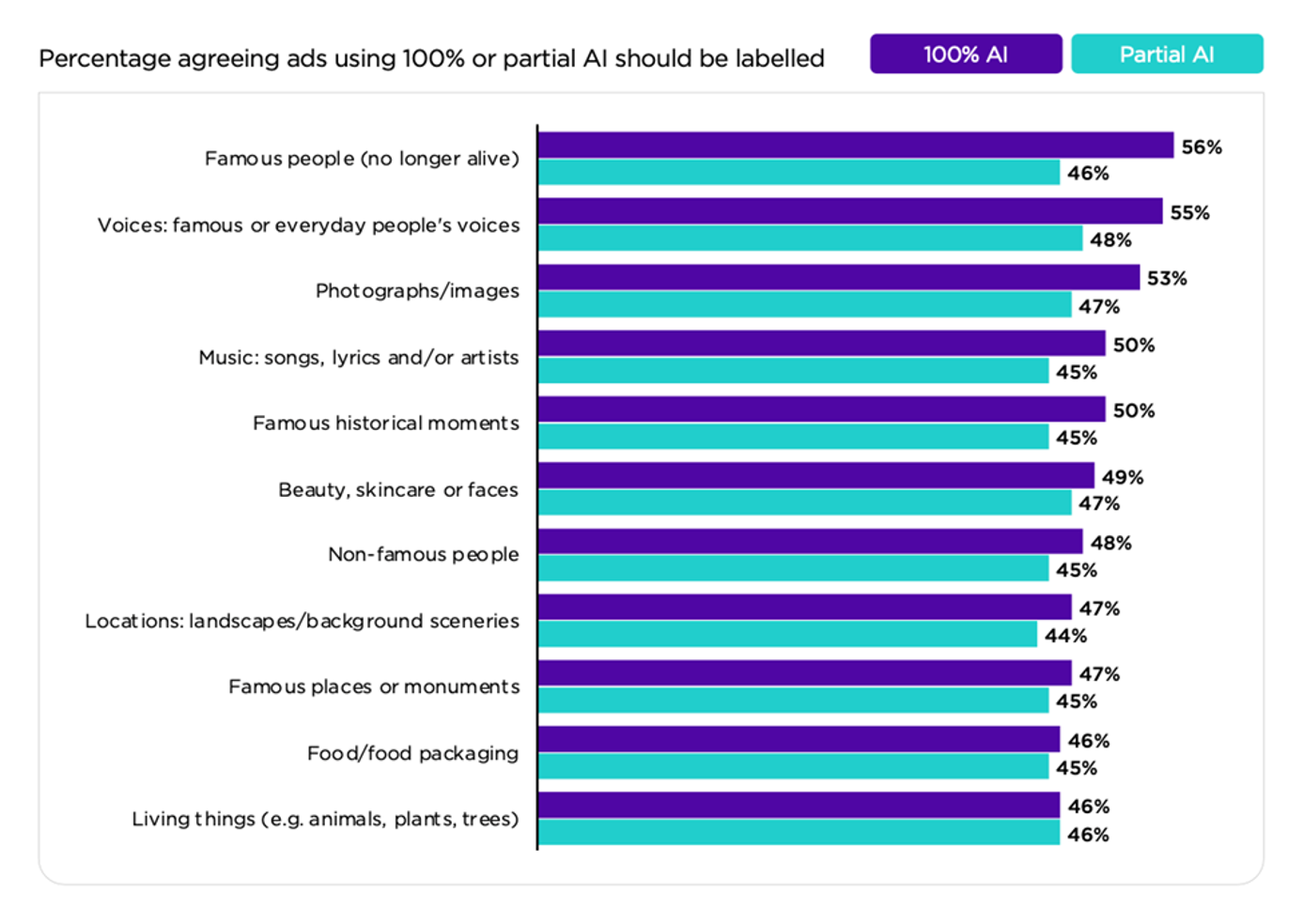
The level of comfort with AI varies greatly according to use case. When it comes to creative that’s 100% generated by AI, the use cases most opposed by Canadians are to generate the likeness of a deceased famous person (57%), to create voices, whether they are imitating a famous person or not (55%) and photographs (54%).
The belief that AI-generated content in ads should be labelled as such is remarkably consistent across age brackets. Just 18% of under-35s believe that there is no need for labels on AI-generated content, which is exactly the same for those aged 55 and over.
The future of AI in TV advertising
It is crucial for advertisers to understand evolving attitudes to AI to ensure integrity and retain trust.
The findings from our survey suggest that if using AI, it is important to be transparent about how you’re using it. Just as any conversations with chatbots should be labelled as such, so should any content generated by AI. If the viewer feels they’ve been duped in any way, this can have a big impact on trust and the brand’s reputation.
Brands using generative AI must also be aware of the risks involved in creating new content. As these models are trained on data that could contain prejudiced or discriminatory data, Gartner recommends having controls in place to check for any biases that could be baked into the content they generate.
As the technology develops, and those uncanny kinks in content it generates are worked out, we may expect to see comfort levels with AI changing among Canadians. For now, however, brands working with generative AI must remember the importance of transparency and authenticity.
To find out more about Canadians’ attitudes to AI in advertising, as well as how streaming behaviours have been changing over the years, download Roku’s Video-on-Demand Evolution 2025 report.