Streaming platforms have always put us in the driving seat. They let us choose exactly what we want to watch, exactly when we want to watch it. It’s why we fell in love with them in the first place.
Today, we want someone else to take the wheel.
More Canadians are craving “lean-back” TV experiences, where they turn on the TV and watch what’s on – without making a selection first – just like we did before the days of Video on Demand. In our Video-on-Demand Evolution 2025 study among more than 2,000 Canadians, more than a quarter (26%) said that they enjoy turning on a TV channel and watching whatever’s on.
This covers traditional live TV, of course, though an increasing segment of the Canadian streaming audience is also tuning into FAST TV, free ad-supported streaming television channels that air well-loved shows and movies back-to-back, 24/7.
Bringing a wealth of streamers to ad-supported channels, lean-back TV viewing is a trend advertisers should be keeping an eye on.
What is lean-back TV viewing?
Let’s define exactly what we mean by lean-back TV viewing. It’s TV content viewed in a relaxed or passive state, such as TV shows and movies, and is often watched on large TV screens from a comfortable distance (so likely in the living room).
Why more Canadians are opting for lean-back TV experiences
Why do more TV streamers crave these lean-back experiences?
It saves them from making a decision – or the wrong one
As anyone who has spent far too long looking for something to watch knows, the more options you have, the longer it can take to make a decision.
Our 2025 study of Canadian streaming behaviour found that on average, streamers spend 11 minutes looking for something to watch. The longest average time they’ve spent in a search for something to watch is more than twice that – 24 minutes.
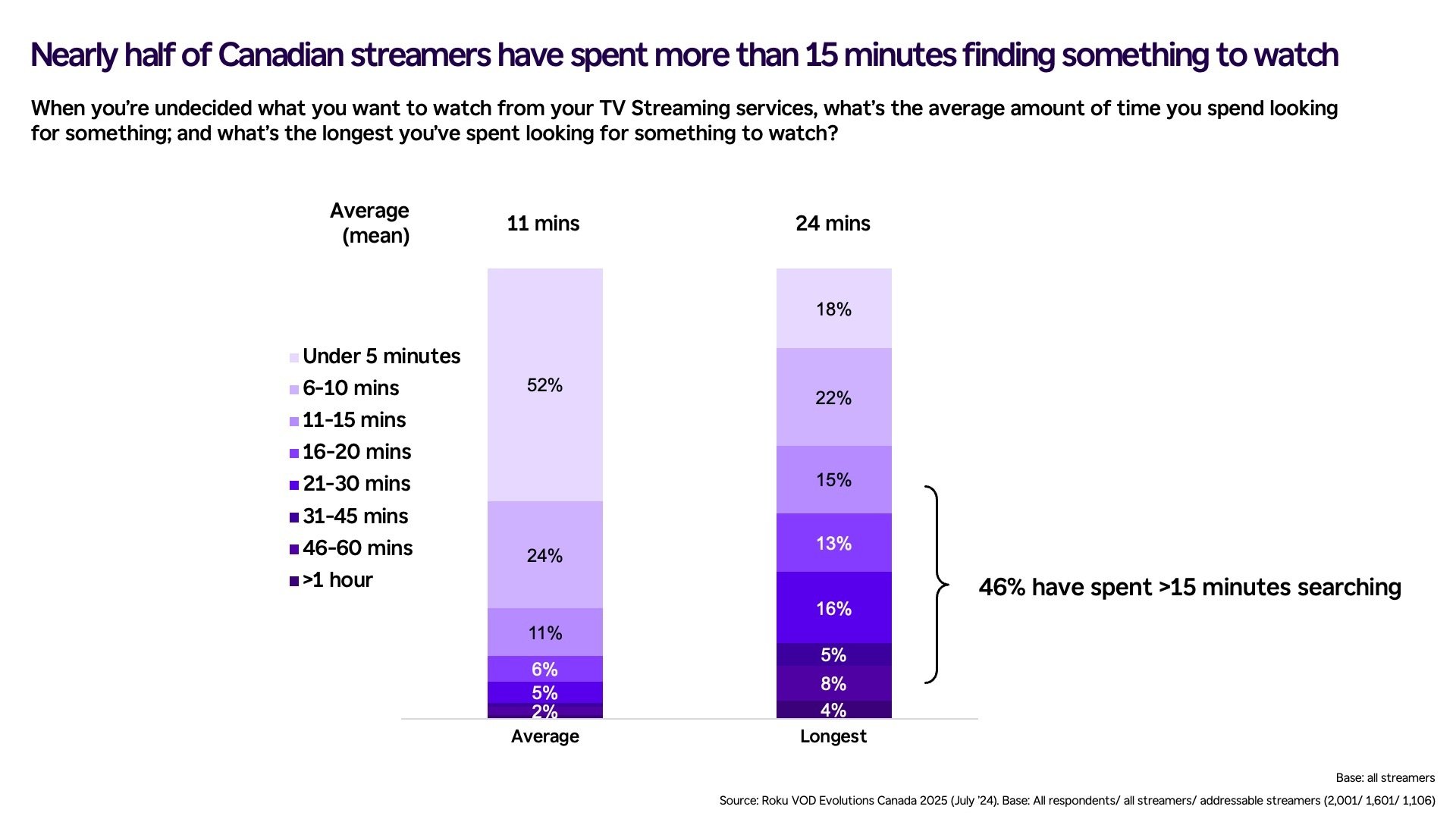
Caption: Nearly half of Canadian streamers have spent more than 15 minutes finding something to watch
That’s a long time to spend scrolling, possibly in a state of stress, when you’re more than ready to just kick back and be entertained. Almost 2 in 5 streamers (38%) agree that it’s “stressful” finding something new to watch on streaming platforms.
Turning on a live streaming channel or FAST channel saves the streamer from having to make a decision, or from the discomfort of making the wrong one.
Streamers like scheduled programming
Our study also found that about a third (32%) of streamers say they miss having a TV schedule to help them find something to watch, and 40% said that they prefer to choose what to watch in a TV channel guide, a percentage that’s up from last year.
A lot of FAST channels look and feel like linear TV – they have scheduled programming and regular ad breaks, giving brands the opportunity to reach viewers while they’re in a relaxed, receptive state.
Live and FAST channels are free
Canadians’ household budgets have been squeezed in recent years. The ad-supported live and FAST channels offered by streaming platforms let streamers enjoy quality TV content at all times, free of charge.
They’re already subscribed and can’t cancel – they’re just a part of the service. There more than 150 FAST channels on the Roku Channel alone in Canada, and this number is rising.
What do lean-back TV experiences look like?
Streamers with no specific show or movie in mind can tune into the following for their lean-back experience:
FAST channels
FAST TV channels are dedicated to a single show or genre, offering streamers round-the-clock episodes of old favourite comedy series, indie movies, or cooking programs, for example. There are also FAST channels dedicated to French language content. By the end of 2024, more than one in five (21%) Canadians were watching FAST channels according to a report by Media Technology Monitor.
Live streaming TV
More than half (52%) of Canadian streamers now watch live TV, as well as on-demand services, via a streaming platform, according to our TV streaming study. A quarter (25%) streamers’ total TV viewing time is now spent with live TV.
Playlists
Another example of leaning back and letting streaming services pick what to watch next, our study identified a desire for curation in the form of TV playlists. These are particularly popular among younger streamers, with about half of whom saying they liked the idea of TV show playlists.
Brands working with Roku can help streamers discover what to watch by curating content playlists that appear on the menu page, so it’s the first thing the viewer sees. Advertisers can create TV show or channel playlists based on a theme, selecting from more than 5,000 available channels.
More than half of all Canadian TV viewers can now be reached via advertising on streaming platforms. To find out more about how streaming behaviour is changing in Canada and the opportunities for brands, download Roku’s Video-on-Demand Evolution 2025 report.