
On any given week, how much time does the average Canadian streamer spend watching brand new TV content?
For example, new shows such as Bridgerton, Wednesday and Squid Game 3 that make a big splash and command huge audiences straight after release?
Just 22%. Canadian streamers spend just a fifth of their TV streaming time watching brand new content, according to our annual study of Canadian TV streaming behaviour. They’re spending twice as much time (44% of total TV streaming time) watching either repeats of shows they’ve seen already, or older library content on demand – that is, older TV shows that they’re seeing for the first time. These figures are virtually unchanged since last year.
What does this mean for advertisers? It means that brands focusing their advertising strategy only on new releases could be missing a substantial proportion of the Canadian streaming audience.
New vs. library vs. repeats: A breakdown of how Canadians spend their TV streaming time
Let’s take a look at how Canadian streamers are spending their TV viewing time in a bit more detail.
In the average week, they spend about two-thirds (66%) of their total TV viewing time with non-live programming, which is split as follows:
New video-on-demand content: 22%
This is brand new, fresh-out-the-can TV and movie content. It includes flagship shows that can get billions of minutes of attention in mere weeks.
Video-on-demand library content: 22%
We call this “new-to-me” content, as it’s not brand new to the world, but it is to the viewer. This means the streamers will likely be watching with the same kind of attention they would with the content in the “new” category, and so it’s still an important consideration for advertisers.
Repeat video-on-demand: 22%
This is content that the streamer has already seen, and may be revisiting for comfort or a pick-me-up.
The remaining TV viewing time covers live or linear content the viewer watches either through cable or streaming. Note: the chart excludes online video.
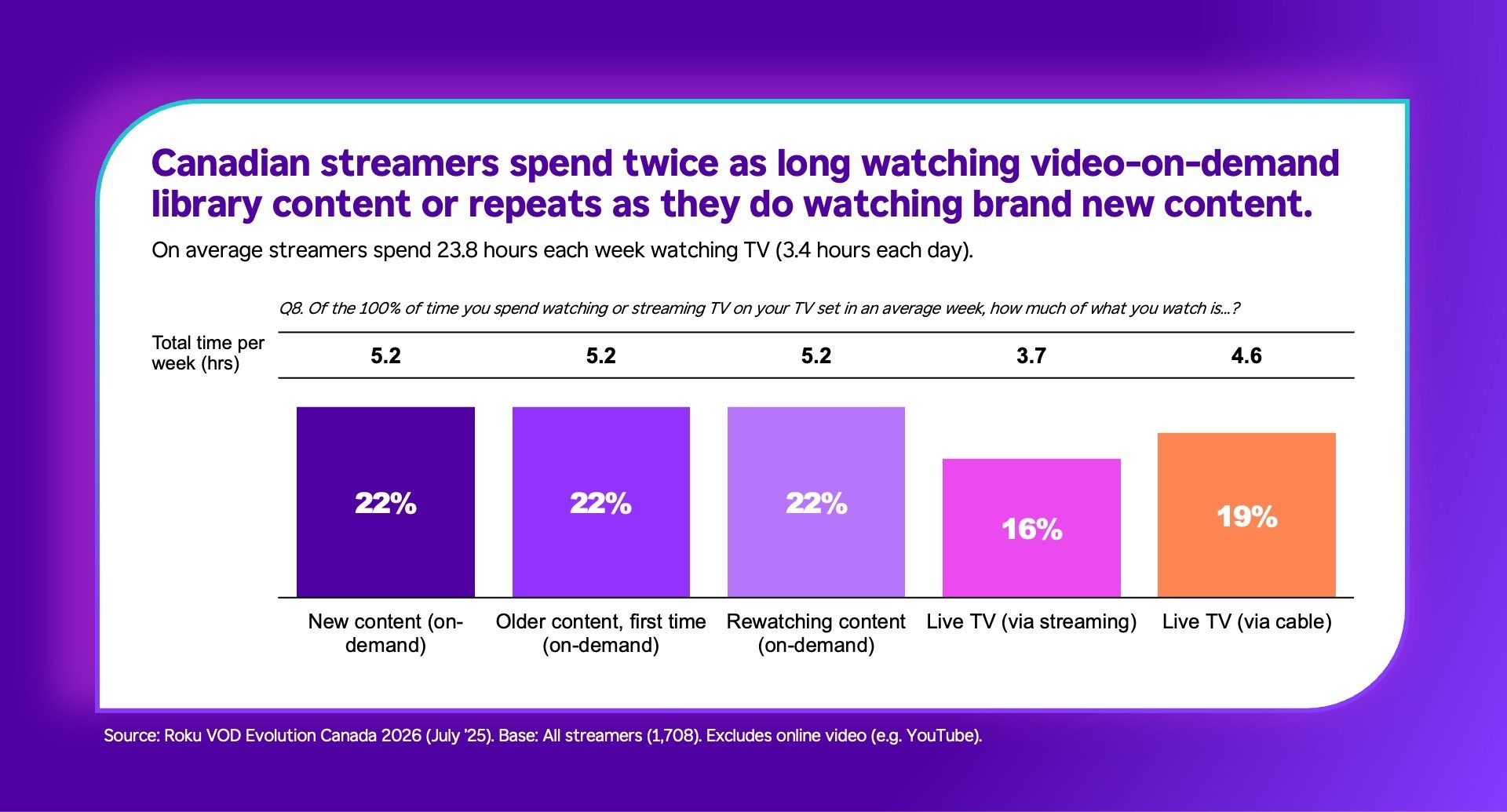
Advertisers playing the long game should think about library content and repeats as well as new content. Although on any given week, these individual library shows won’t put up the same numbers as new shows, as a whole, they’ve got the newbies beat in terms of time spent with them. That’s a lot of attention to consider.
Canadian streamers love repeats. What does this mean for advertisers?
In the latest VOD Evolution study, the majority (62%) of streamers told us that they enjoyed watching “old” TV shows – those more than 10 years old, while a similar proportion (61%) said that they “really enjoy” rewatching TV shows and movies they've already seen.
While streamers may be choosing to watch something tried-and-true to avoid disappointment, it’s important to remember that rewatching often fulfils an emotional need. Research has shown that people watch TV shows they love again and again for familiarity and comfort.
Additional recent research suggests that rewatching shows helps people appreciate how much they’d grown compared with when they first saw them.
Repeat content also solves a problem. It saves them from having to decide on something new to watch, which two in five (44%) said they found “stressful”. Our survey found that streamers spend an average of 12 minutes looking for something to watch, while the longest average time they’ve spent is 31 minutes. Falling back on an old favourite guarantees we won’t be disappointed with our choice, at a time when the last thing we want to do is make another decision.
Planning TV streaming ads for library and repeat content
Evidently, repeat TV fulfils many audience needs. So can ads. Brands advertising with Roku can lean into that appetite for repeats and library content by creating themed playlists of TV shows or channels, which the streamer can open straight from the home screen.
Choose content from channels across Roku. Consider theming it by mood, holiday or genre to align it with the brand and help them discover a new favourite.
Getting the tone right is important. Streamers have told us that they’re more likely to pay attention to ads that reflect or are relevant to their mood – our research found this to be the case for half (50%) of streamers. A similar proportion (51%) prefer when TV ads match the tone of the program they appear in.
Context is important in advertising. Advertisers can be confident that campaigns on Roku will be served to appropriate audiences, as we understand who’s watching.
To find out more about how TV streaming behaviour is changing in Canada and how to identify advertising opportunities, download Roku’s Video-on-Demand Evolution Whitepaper: 2026 Edition.