
Roku's 2026 Predictions
Executive Summary
In 2025, streaming surpassed the combined usage of cable and broadcast.1 In the wake of this big milestone, what’s in store for 2026?
With majority adoption, we can expect some important shifts that will impact everyone in our industry: viewers, marketers, publishers, and platforms alike.
In Q4 every year, we analyze Roku's platform data and combine it with our macro view of the streaming marketplace to present a handful of informed predictions for the ensuing 12 months.
- TV gets way more personalized
- The ad-free viewer goes extinct as 100% of audiences see video ads
- CTV offers a safe space as AI eats the internet
- TV collides with the creator economy
- Hyperlocal advertisers embrace CTV, following the lead of political campaigns
Best wishes for a happy and successful 2026!

Sarah (Warner) Harms
VP of Advertising and Marketing
Roku
1. Nielsen Gauge, June 2025

In our current golden age of CTV, everything can be streamed. With so much content to choose from across TV, movies, sports, and creator channels, discovery becomes a bigger challenge.
Enter AI. In 2026, a new wave of AI-driven personalization will shrink the time it takes viewers to find their next watch. Streaming platforms will become more responsive to individual tastes. Meanwhile, more publishers will invest in building the kind of personalization algorithms that have driven success for Netflix and YouTube.
The challenge of matching users to the right TV content is not really new, but it has gotten worse. In 2025, streaming viewers spent as much as 20 minutes on average to find their next watch,2 up from 7.5 minutes in 2019.3 In 2026, AI-driven recommendations will reverse the trend.
These recommendations will be expressed at both the platform and app level. Upon firing up their TVs, viewers will encounter more personalization on the home screen and throughout the OS experience, receiving tailored suggestions as they search and browse titles. And for streaming publishers that take advantage, personalization will improve engagement and reduce churn — helping them catch up with Netflix, the OG of content personalization.
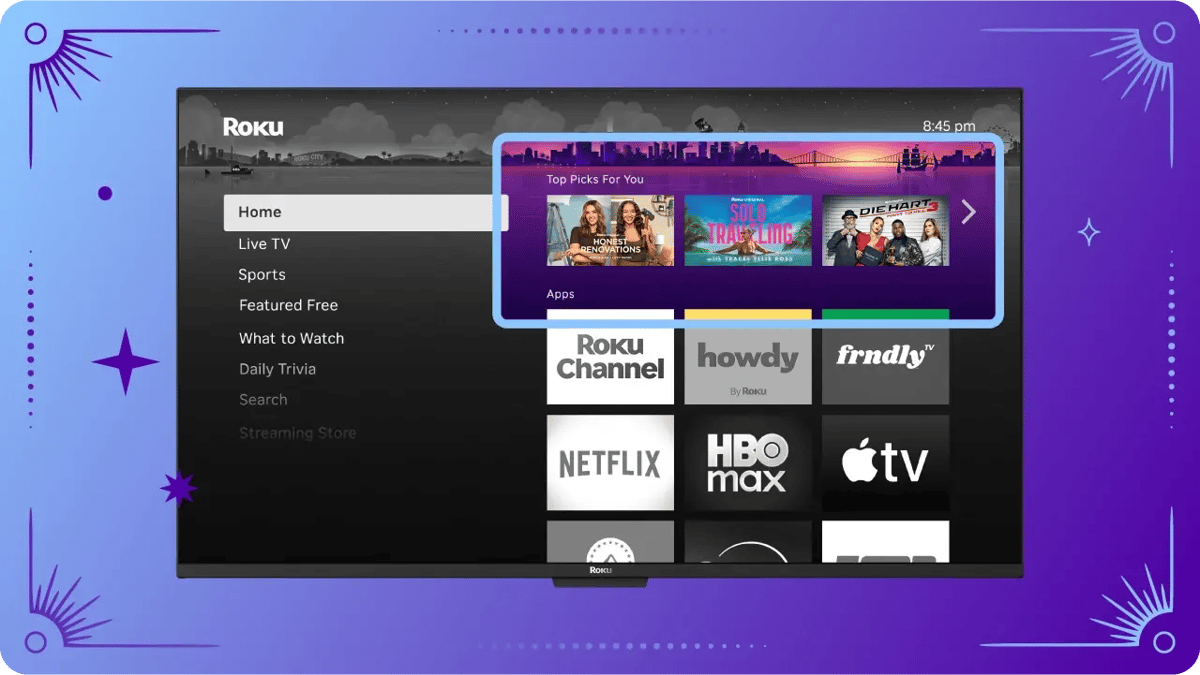
Roku's Home Screen Top Row displays personalized content recommendations.
Netflix's vaunted recommendation engine has long made its viewing experience stickier. Its recommendations influence a whopping 80% of viewing hours4 and expand its “effective product catalog” roughly 4x compared to a non-personalized system.5 Lately, Netflix has teamed up with OpenAI to improve discovery further with conversational search and other capabilities that can identify the best shows for an individual at a particular time.6
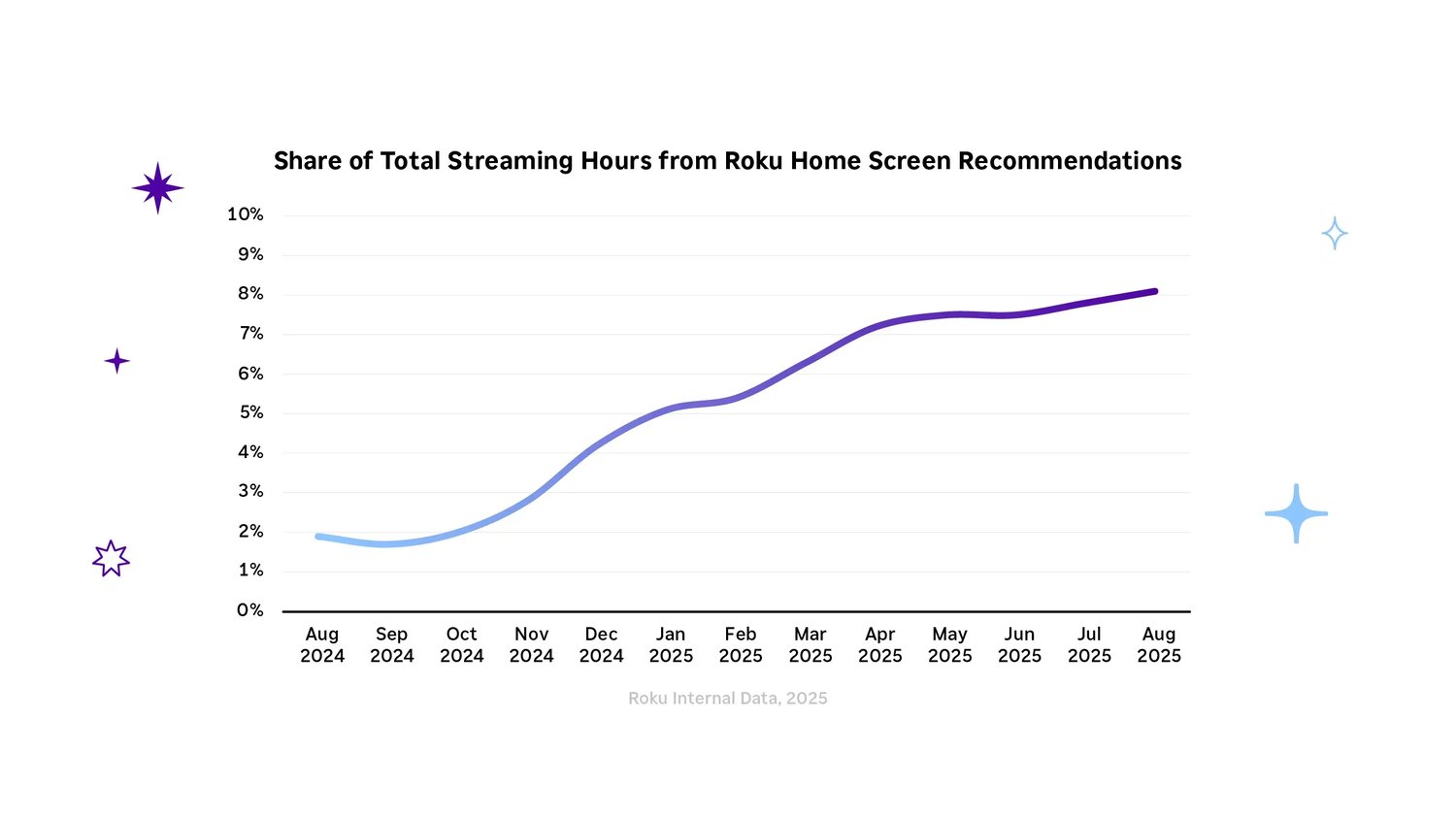
Netflix is far from the only innovator in personalized TV. YouTube’s content recommendations drive 70% of viewing on its platform.7 As of August, the share of hours originating from Roku's content recommendations on the Home Screen more than quadrupled YoY.8
“Roku has invested heavily in giving viewers the most personalized experience possible, and we're now doubling down on those efforts,” said Preston Smalley, VP of Viewer Product, Roku. “When viewers power on their Roku devices in 2026 and beyond, we want the discovery process to feel more effortless than ever.”
We expect other streaming apps to follow. Free, ad-supported streaming options — such as The Roku Channel, Tubi, and live linear streaming channels — have a huge opportunity to boost popularity and retention by combining AI tools with first-party data. Of course, personalization in streaming is not only about surfacing the right content. It’s also about how entertainment is presented to viewers, such as highlighting specific actors, athletes, or clips that appeal to a viewer’s individual tastes. In this way, AI will become “boring” in 2026 as it fades into the background, invisibly making how we find content more seamless and efficient.
For advertisers, AI and automation have already boosted the precision and efficiency of their streaming campaigns. As a result, audiences are seeing more ads that resonate — something we know they want. Seventy-two percent of viewers9 in a Roku study last year said they pay more attention to ads that reflect their interests and shopping habits.
In 2026, we predict personalized TV advertising will grow considerably thanks to supply and data integrations such as those Roku has with Amazon, The Trade Desk, and other partners. Steady improvements in identity resolution across streaming apps and platforms will accelerate this process.
“AI and programmatic are transforming how we activate client data, unlocking a new level of performance in CTV,” said Jim Kensicki, US Head of Activation, WPP Media. “By connecting our AI-powered solution, Open Intelligence, with rich data from our own ecosystem and partners like Roku, we’re translating cross-platform signals into more intelligent targeting and personalized creative. This ensures that we reach the right audiences at optimal moments of receptivity, with messages that are relevant to their needs and context.”
2. Comscore, 2025
3. Nielsen, September 2023
4. Netflix Inc., December 2015
5. Netflix Inc., December 2015
6. WPP Media, September 2025
7. Business Wire, April 2025
8. Roku Internal Data, 2025
Years ago, when the first wave of cord-cutters flocked to subscription video-on-demand services like Netflix, marketers worried that TV audiences could “disappear” behind pay walls as ad-free streaming took over. Then, the opposite happened.
Today, a supermajority of Roku streaming households (96%!) sees video ads somewhere along their journeys,10 and Nielsen reports that content with ads accounts for nearly 74% of all TV viewing.11
As ad-supported streaming continues its growth story, “unreachable” viewers will go the way of Blockbuster Video, as 100% of viewers see ads in 2026. With this change, advertisers will embrace free, ad-supported streaming (FAST) apps.
YouTube is a major reason for this shift. With so many Americans watching YouTube at least occasionally, and most YouTube viewing including ads, it’s a key platform for video ads reaching viewers.
Amazon has also contributed to the swing to ad-supported streaming. The company turned ad-free viewers into ad-supported viewers when it began showing ads to all Prime Video users in 2024 (unless they paid $2.99 a month to continue an ad-free experience). Ad-supported Prime Video now reaches 130 million US customers.12
Today, all major streaming services offer some sort of ad-supported tier, except for one: Apple TV. (Although even that is debatable, since Apple has already featured limited advertising in some live sports events, such as Major League Soccer coverage.13)
Audiences are rushing toward these ad-supported offerings. Subscriptions to services with ads included increased 32.7% in Q2 2025 compared to the previous year.14
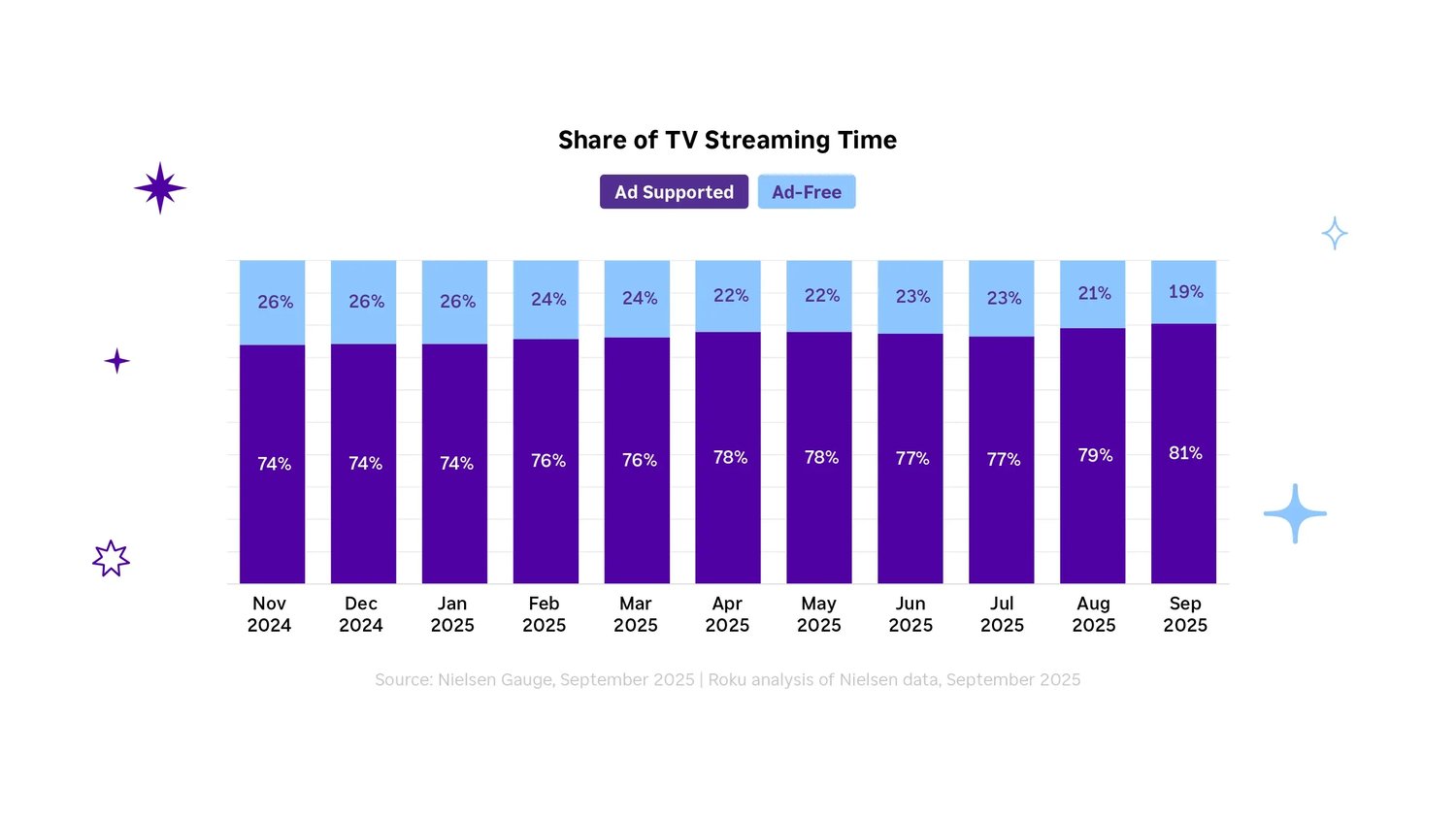
Aside from ad-supported subscriptions, US households with 125 million people see the Roku Home Screen every day. Our Home Screen Marquee ads and other ad formats in the Roku experience are unmissable and designed to augment the streamer experience rather than interrupt it.
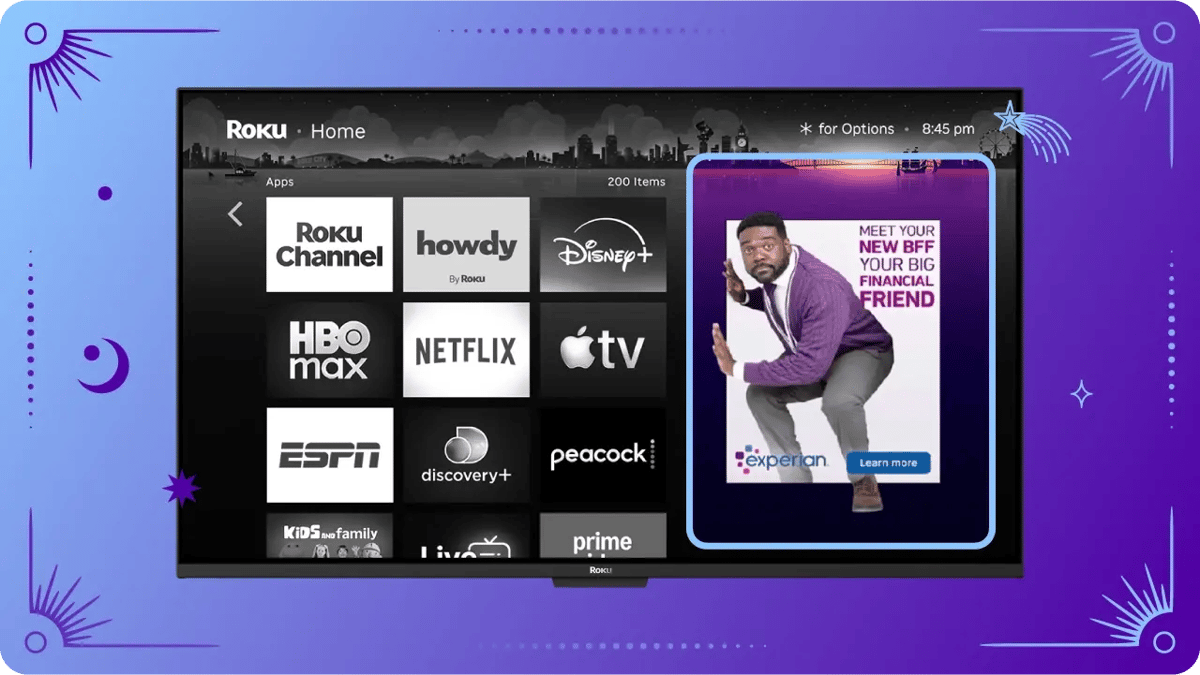
Home Screen Marquee Ads surprise and delight viewers along their journeys.
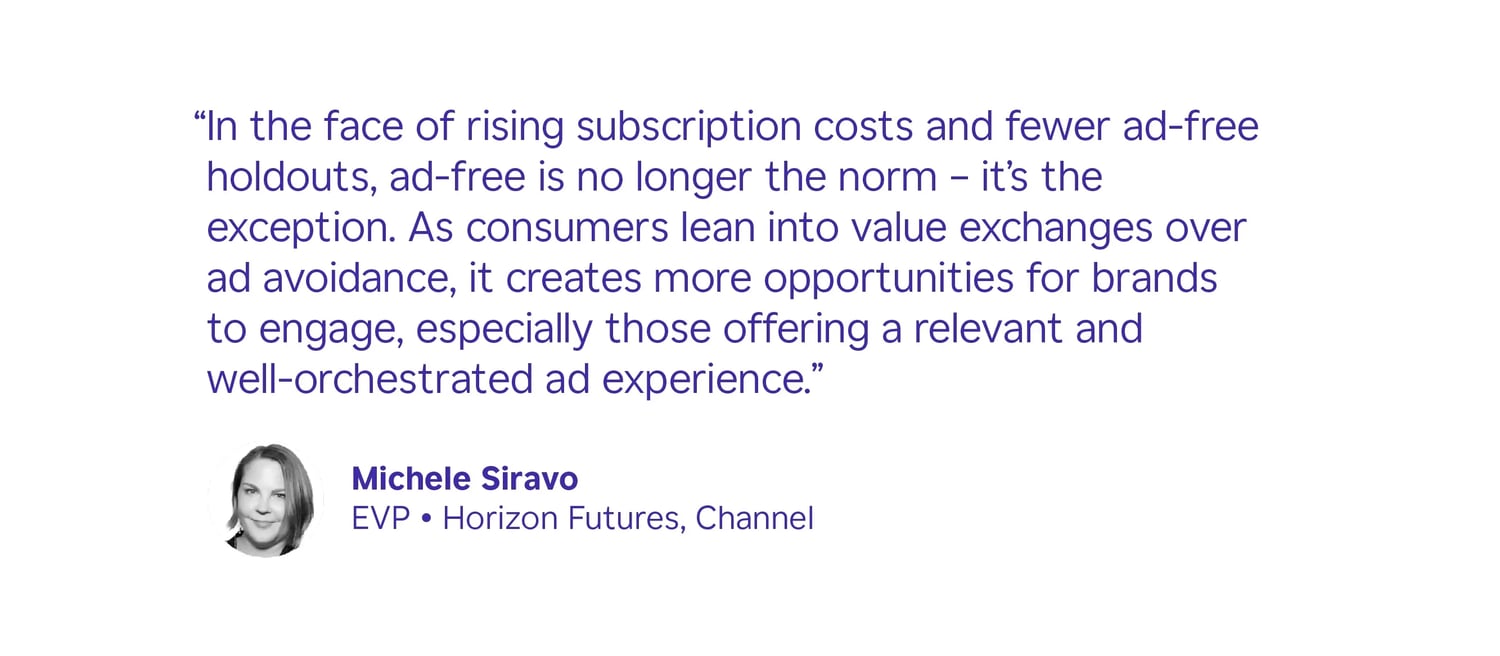
“In the face of rising subscription costs and fewer ad-free holdouts, ad-free is no longer the norm — it’s the exception,” said Michele Siravo, EVP, Horizon Futures, Channel. “As consumers lean into value exchanges over ad avoidance, it creates more opportunities for brands to engage, especially those offering a relevant and well-orchestrated ad experience.”
With mass adoption of ad-supported streaming will come wider advertiser acceptance — especially when it comes to free streaming apps. The sheer popularity of FAST will cause marketers to embrace free streaming apps more enthusiastically than they have in the past.
To put some numbers around the prevalence of free streaming: As of October, The Roku Channel and Tubi accounted for 5% of total viewing time — more than either Prime Video or Disney alone.15 Many FAST channels have upped their game and improved the user experience, driven by intense competition. Younger audiences in particular love FAST channels, with more than two-thirds streaming at least one, according to Deloitte.16 In 2026, we predict that FAST channels will reach a 10% share of total TV viewing.
With viewers and publishers running toward ads, there is a risk that some publishers will push things too far, alienating audiences. We believe some viewers will revolt in 2026, voting with their remotes to avoid services with egregious ad loads.
Most streaming services show ads for between four and eight minutes per hour, according to Wurl.17 Amazon kicked off with two to three-and-a-half ad minutes per hour, but that increased18 months later to four to six minutes per hour.18 So far, no major players have dared to embrace the ad loads of linear TV, which can stretch to 16 minutes.19
We are moving away from a world where publishers and platforms constantly interrupt the viewer experience and toward one that lightens the ad burden on streamers while still allowing brands to participate in their journey. Something tells us the viewers won’t mind.
“Today, ads are integral to the streaming ecosystem,” said Lauren Benedict, VP of Sales, Roku. “In this world, it's incumbent on our industry to make sure the ad experience brings value to viewers’ lives. That's something we're approaching through thoughtful and integrated partnerships, great culturally relevant storytelling, and an audience-first ethos through deterministic data.”
9. Roku + Dentsu, 2025
10. Roku Internal Data, 2025
11. Nielsen, July 2025
12. Hollywood Reporter, May 2025
13. eMarketer, November 2022
14. Antenna, Q2 2025
15. Nielsen, November 2025
16. Deloitte, 2025
17. Adweek, June 2025
18. Adweek, August 2025
19. Adweek, August 2025
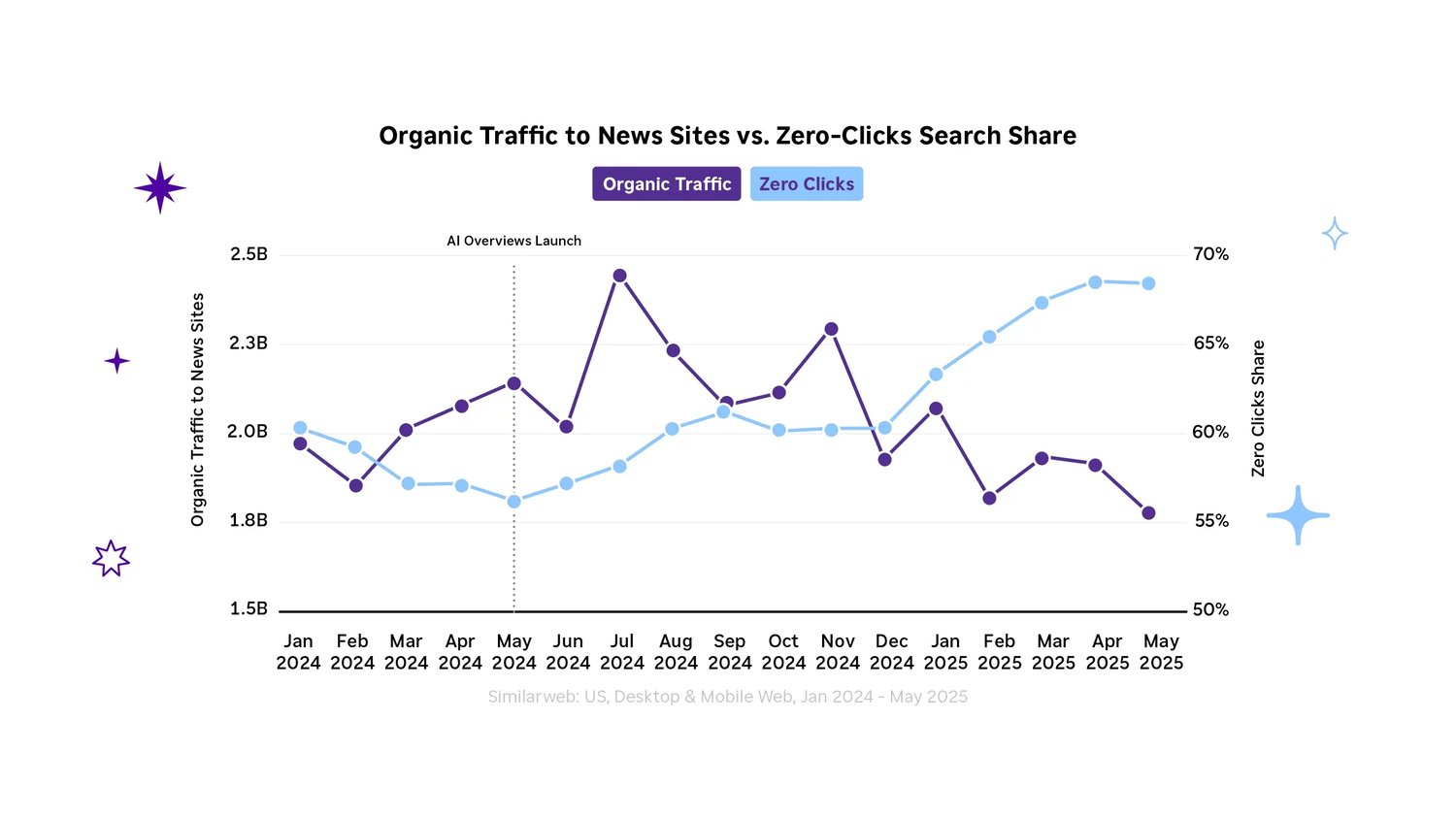
During their meteoric rise, powerful new Gen AI models have already affected two critical performance channels: search and social. With search in particular, AI summaries are replacing the need for traditional search results — causing traffic and ad volume to decline. This puts marketers and media companies in a challenging position, as they seek to preserve access to their audiences in a changed world.
In 2026, both marketers and publishers will look to CTV, which is largely insulated from the most disruptive effects of gen AI. Beginning in the second half of the year, marketers will move budgets out of those channels and into CTV. Specifically, we believe up to 50% of streaming advertisers will subsidize CTV ad spend increases with budgets siphoned from search and social.
After all, people still want to watch a season finale — not a synopsis of the finale. And when we talk about “TV-caliber content,” that implies a dedication to high-quality production values. Not incidentally, TV audiences continue to gravitate to reality content, whether that means reality TV or polished creator videos — which is the very opposite of “AI slop.”
To take these one at a time:
Search: The rise of “zero click” searches has already dinged ad volume, with consumers who embrace AI “answer engines” clicking through only about half as often as they do in traditional search.20 For marketers, this trend will shrink the surface area for intent-based search ads and erect a barrier between their brand and consumer research. For publishers, the impact is more existential, as AI overviews threaten crucial monetizable traffic.21
Social: Gen AI has seriously blurred the lines between synthetic and authentic content, which comes with risks. In November 2024, AI-generated articles surpassed human-written articles in quantity,22 and 58% of consumers say they often can't tell the difference between real and AI-generated content.23 The avalanche of “AI slop” creates brand safety headaches for marketers, with offensive content up 72% YoY.24 The result raises questions about the future viability of a channel that already provides diminishing returns for some growth marketers.
By contrast, streaming is protected from many of these pain points. The channel continues to provide a safe and high-attention media environment — along with an improved ability to measure outcomes.
“CTV continues to play a pivotal role in the evolving digital advertising landscape,” said Jamie Finstein, Vice President, Media Center, IAB. “Brands recognize its value across the media mix, driving awareness at the top of the funnel while also delivering on business outcomes."
CTV ads deliver strong levels of viewer attention and measurable impact, and advertisers are taking notice. Already, 36% of advertisers who plan to spend more on CTV will redirect those dollars from social, according to IAB, while 32% plan to reallocate those budgets from paid search.25 It’s reasonable to think the proportion of advertisers opting to move money from search and social over to CTV will increase again in 2026.
When the brand fatty15 wanted to drive awareness26 of its healthy-aging supplements, for example, it chose interactive CTV ads over cluttered social media environments. Its successful campaign drove more than 97,000 page views and a 120% return on ad spend.
While neither search nor social will go away soon, pressures on both channels will lead many advertisers to “hedge” their media mix by ramping up CTV spend in Q3 and Q4.
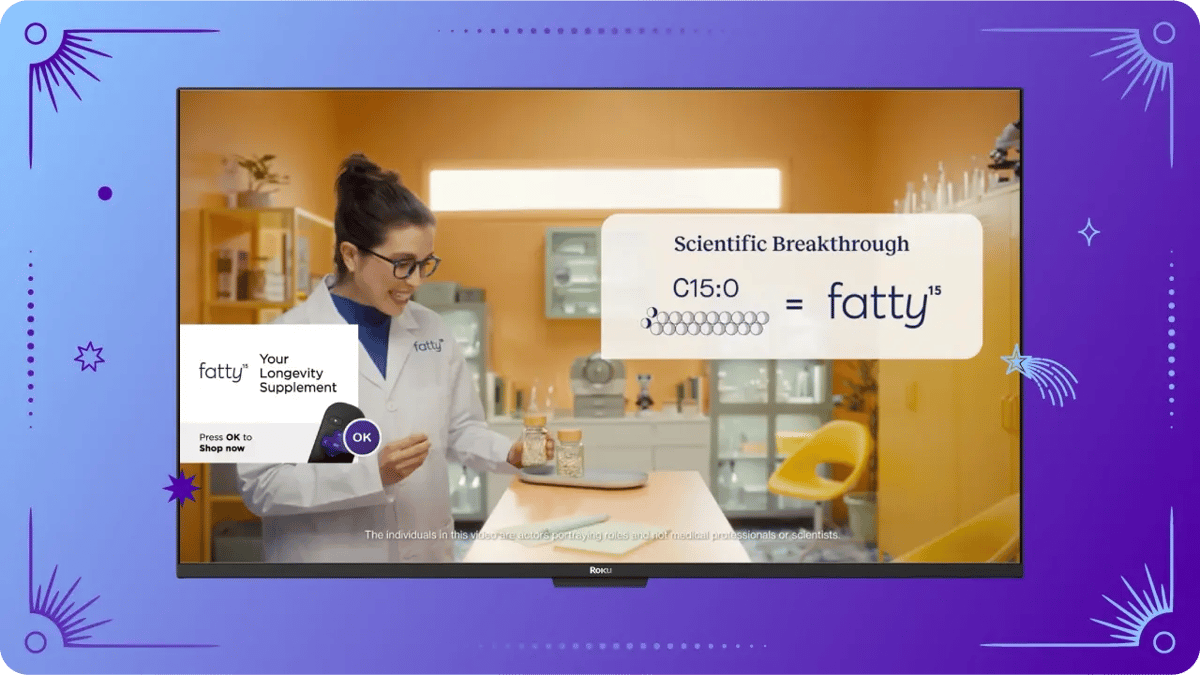
Wellness brand fatty15 used Roku Action Ads to drive over 97,000 page views.
“As AI destabilizes search and social becomes a minefield for brand safety, CTV remains a resilient, well-instrumented channel where we can innovate under the hood while preserving the integrity of the content relationship.” said Soumitro Tagore, VP of Engineering and Advertising, Roku.
20. Pew Research Center, July 2025
21. BBC, September 2025
22. Graphite, 2025
23. Reuters Institute, 2025
24. Integral Ad Science
25. VideoWeek, April 2025
26. Roku Advertising, July 2025
The creator economy is booming, with some 50 million creators making and monetizing content for 5 billion social media users globally, according to Deloitte.27 While social media platforms enabled their rise, the next wave of growth for these video content innovators is likely to come from streaming.
In 2026, creators will expand their presence on connected TV through licensing, ads, and more. And at least one major streaming service beyond YouTube will add a “creator” tab to make it easier for users to find popular creators.
Operating like full-blown production studios, creators are at the forefront of innovation in storytelling, with the most successful among them building TV-scale fanbases. YouTube, again, has been a driving force here. Its centrality to the creator economy has propelled it to a leading position in CTV — with 12.9% of total TV viewing.28 YouTube spent $32 billion on content in 2024, according to KPMG, representing a growth rate well beyond other media giants.29
Creators, however, have made significant inroads beyond YouTube. Tubi launched its “Tubi for Creators” program in June and now has episodes from MrBeast, Jomboy Media, Alan Chikin Chow, Steven He, and others.30, 31
Additionally, many popular podcasts have evolved to include video — making them well-suited for TV devices.
But years before these developments, Roku and other platforms saw the value creators can bring to viewers. In 2023, we partnered with Jellysmack to launch FAST channels with popular creators,32 which we know can attract new audiences and expand our content catalog. Samsung is also bullish on creators. Samsung TV Plus has partnered with Mark Rober, Dhar Mann, Michelle Khare, and other creators to bring their content to the service.33 That includes launching a FAST channel with Rober and co-producing original programming with Mann.34
These bets are paying off: In August, viewership of creator-led content on The Roku Channel grew nearly 80% in streaming hours per household YoY.35
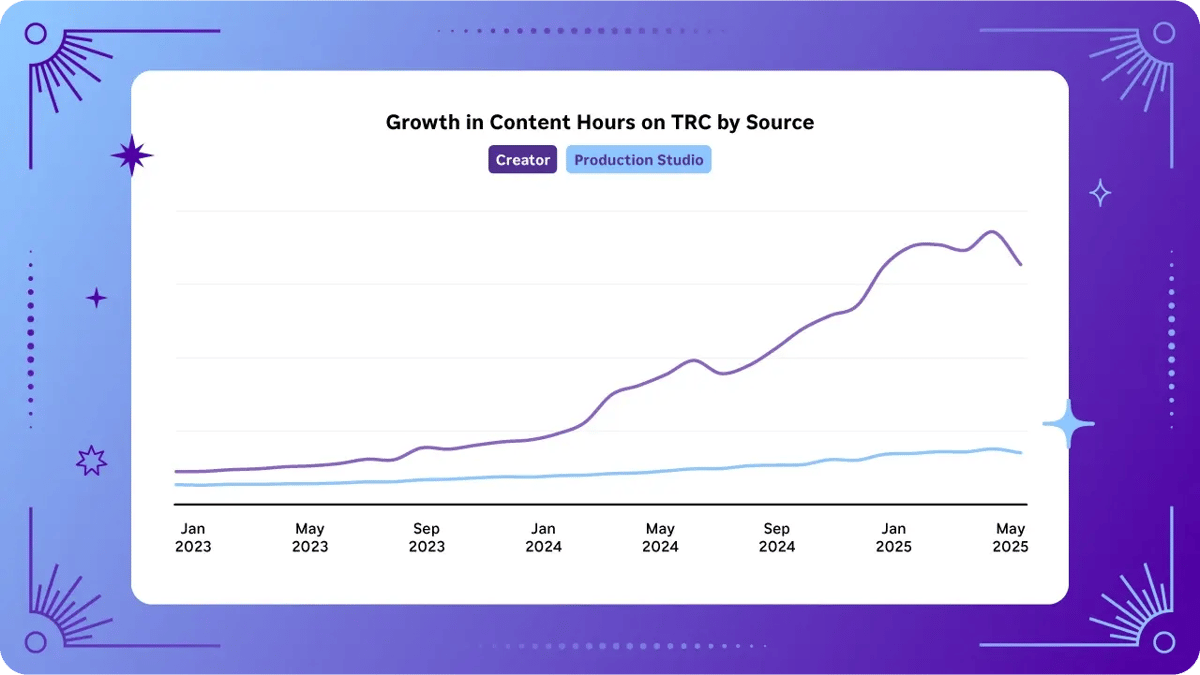
“Viewers want content that aligns with their interests,” said Lisa Holme, Head of Content, Roku. “That's why Roku has long supported creators through The Roku Channel, giving our viewers access to some of digital's most popular media innovators.”
Marketers should expect even more creators to make the leap to CTV in 2026, and their streaming activities will be multifaceted. For example, CTV ads will help some popular creators extend their existing ecommerce and sponsor activities through interactive and native streaming ads units, such as ads on the Roku Home Screen and Roku City. CTV also gives creators a sense of validation and lets them command higher rates, enabling them to scale and reach wider audiences.36
“When creator content runs alongside the programming that audiences already watch on television, we see greater ROI using creators’ name, image, and likeness across social platforms,” said Ryan Detert, CEO at Influential.
For marketers, this shift will let them partner with creators to engage fan communities on the largest screen in the home. Between Q3 2023 and Q4 2024, shoppable activations that combine talent and stories were shown to boost engagement by 378% across NBCUniversal properties.37 That hints at a large opportunity.
27. Deloitte
28. Nielsen, November 2025
29. KPMG
30. Tubi, June 2025
31. Tech Crunch, June 2025
32. Variety, 2023
33. Samsung, July 2025
34. Samsung, July 2025
35. Roku Internal Data, August 2025
36. Digiday, September 2025
37. Marketing Brew, May 2025
Sometimes, even during massive change, what’s old becomes new again. We’re about to see this happen with local advertising — a mainstay of TV that has been largely absent from streaming.
Today, streaming has the scale to help regional advertisers find hyperlocal audiences in a way that affiliate stations in linear TV have long done, with all the tools to optimize and prove performance. But streaming TV’s capabilities go beyond linear. Auto dealers, restaurants, medical offices, and other local advertisers can target CTV ads down to the ZIP code level.
2026 will be a tipping point for locally targeted campaigns thanks to the midterm elections. Political campaigns will lead the way, proving that self-serve TV ads combined with AI-generated creative can help candidates turn out the vote. Seeing this, law firms, hair salons, real estate agencies, and other regional businesses will follow.
Local ad dollars are already flowing to CTV, reaching an estimated $2.8 billion in 2025 — about 8% of all local video advertising.38 Gen AI is already greasing the gears for these hyperlocal campaigns, helping them quickly build and launch creative customized for their markets.
“CTV gives our local advertisers reliable reach and audience granularity,” said James Kelm, VP of Products, Ads, and Media, Roku. “In 2026, we’ll be able to pair county and state-based targeting with AI-driven creative pipelines to generate localized variants at scale. The result will be operationally efficient campaigns for smaller advertisers, with the instrumentation to measure and iterate quickly.”
Importantly, targeting geographically doesn’t mean going small. When Freeway Insurance used Roku Ads Manager to connect with streamers in Florida and other markets, its campaign drove 2.2 million page views on their website and 336,000 new auto vertical leads.
“The option to create local campaigns and invest more money in specific states is a huge win for us and a reason we’ll be including Roku Ads Manager on future marketing campaigns,” said Alejandra Morales, Media Director at Confie, Freeway’s parent company.
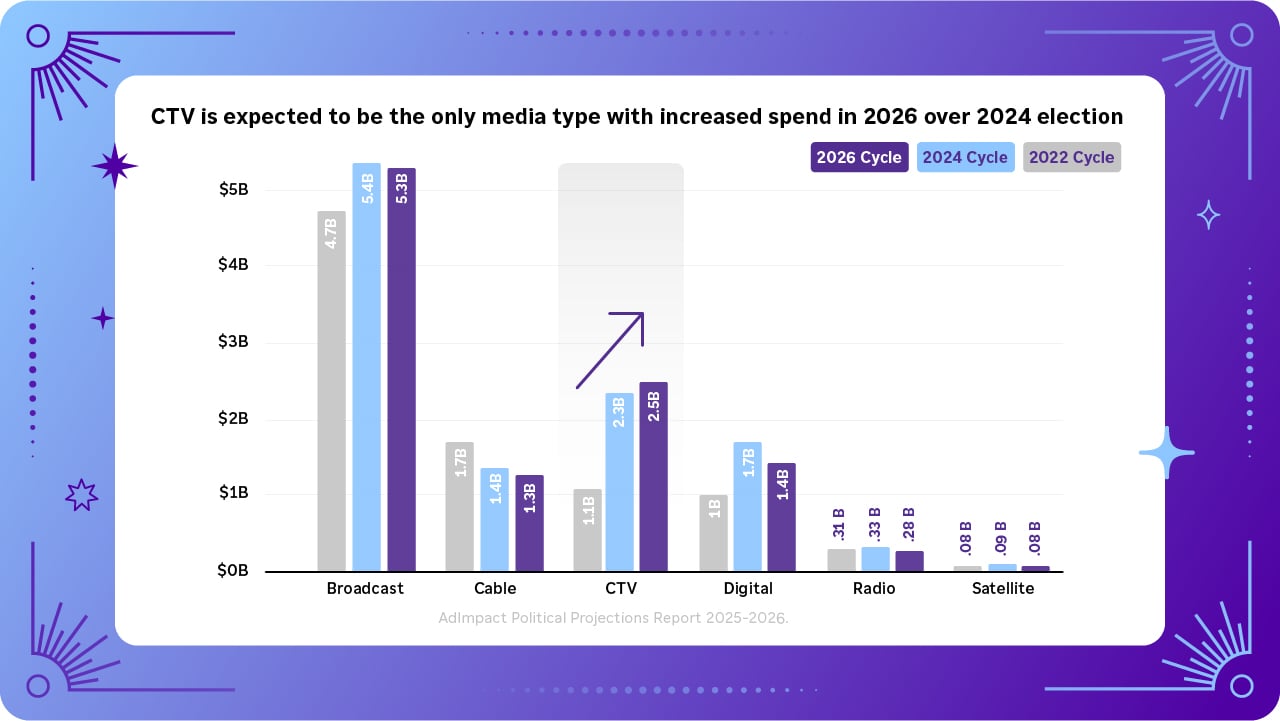
In 2026, we predict that generative AI-powered creative will help many local advertisers boost the effectiveness of their ads by 30% compared to linear. And for regional and national brands that operate local franchises, it will become way easier to test dozens or even hundreds of ad versions in the markets where they operate.
Say hello to streaming-first campaigns that more fully leverage AI and data to overcome hurdles like ad saturation and make their media dollars go further.
38. Bia, 2025
39. Ad Impact, September 2025
40. Nielsen, 2024
41. Axios, February 2024
Conclusion
Today, US viewers spend more time streaming on Roku-powered devices42 than watching traditional broadcast television. With nearly half of all US TV streaming taking place on a Roku device,43 we have a unique perch to understand the changes reshaping the industry.
We pride ourselves on giving advertisers the authenticated reach and innovative tools they need to meet their business objectives. When Roku brings better TV for everyone, we all win: viewers, advertisers, and partners.
We look forward to helping you successfully navigate these trends in 2026.
42. Roku Advertising, September 2025
43. Based on Comscore data, by hours streamed
The foregoing contains “forward-looking” statements that are based on our beliefs and assumptions and on information currently available to us on the date of publication of this article. Forward-looking statements are not historical facts, and include statements relating to, among other things, predictions relating to advertising developments in 2025. Except as required by law, we assume no obligation to update these forward-looking statements publicly, or to update the reasons actual results could differ materially from those anticipated in the forward-looking statements, even if new information becomes available in the future.