Roku wants to make its platform easy for everyone to use, says Julian Riediger, director of product, privacy. “That's Roku’s No. 1 principle—not only for advertisers, but also for consumers.”

This philosophy guided his team’s development of a clean room, a secure environment where Roku and its partners can share data in a privacy-centric way. Clean rooms are relatively new, but play an increasingly important role in enabling data collaboration in TV streaming.
We spoke to Julian about Roku’s approach to privacy, the benefits of clean rooms, and how Roku’s road map will facilitate greater data collaboration with brands.
Please tell us about your background and purview at Roku.
I am an engineer by training. I have worked at companies small and big, including a major marketing data collaboration and onboarding platform, where I was exposed to privacy challenges from an advertising and consumer perspective. This eventually led me to join Roku to establish a function with a product-centric view on privacy.
My team focuses on three areas. The first is user privacy and ad integrity, which includes controls we provide to our users wherever they are engaging with Roku.
The second pillar is privacy infrastructure and compliance, which focuses on ensuring that we're compliant with all regulations in the markets where we're operating and bringing these distinct requirements together into a cohesive product.
The third area is data collaboration and Roku’s clean room.
Why is a clean room such an important technology for data collaboration?
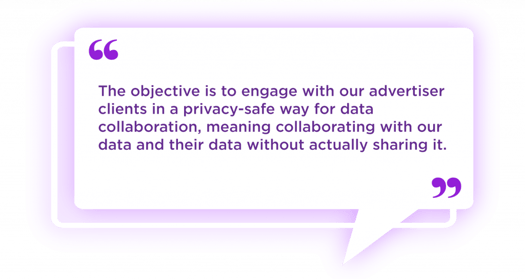
There are a few things that are really exciting. One is the privacy aspect of the clean room, which means collaborating without actually sharing the data and running use cases on top of that data to provide insights.
It's an enabler of collaboration, which is the second exciting thing. Since we can now operate audience enrichment, analytics, measurement, and activation in a safer way, Roku can give advertisers access to more up-to-date insights about Roku’s first-party data assets, which is a value-add. Our customers aren’t dealing with old data they received one or two months ago.
We're also increasing speed because we're allowing advertisers to directly connect to our platform. If they want to activate audiences, the turnaround is hours instead of days.
Clean rooms are a great example of something you can do now that you weren't able to do before. It's about protecting privacy and providing valuable insights faster. That's an important consideration for someone wondering if they should use a clean room.
What new kinds of data are now available through Roku’s clean room?
At the core of Roku's clean room, we have Roku household data, and, most recently, we added automatic content recognition data (ACR) that we collect across our TVs. Currently, we're working on adding and refining our data sets, so we expect more to come here soon.
What are the ideal use cases for clean rooms?
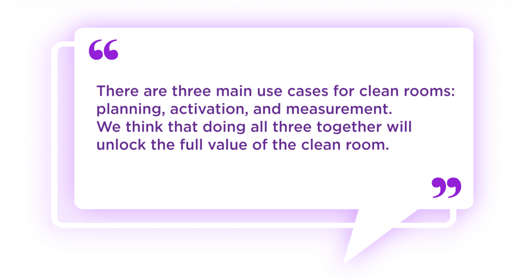
The advertiser can then activate through the clean room into OneView, where they can run a campaign. Once the campaign is running, the exposure data flows back into the clean room. The advertiser can then bring in conversion data for campaign measurement.
Then they start the cycle over again and refine and tweak. We are envisioning a continuous cycle of planning, activation, and measurement. Some clients only use the clean room for measurement today, but from a long-term vision perspective, I think that's ultimately where we're heading.
What enabling tech did Roku use in its clean room set-up?
We decided to build our clean room on top of Snowflake. We realized that a lot of advertisers already use Snowflake as their infrastructure and have their data in a Snowflake instance. If advertisers are using Snowflake today and have their data in Snowflake, it's relatively easy to get started with our clean room.
What does it take for advertisers to get set up?
The process is relatively straightforward. First, they need to have a Snowflake account. Second, they need to have their data in there or pull it from one of their systems. They can then install our clean room and configure what data they want to bring into it.
What’s on the roadmap for Roku’s data collaboration efforts?
We’re thinking about three angles. The first one is continuing to make it easy to work with us. We want to expand the clean room from Snowflake to other data infrastructures and work with partners to make that connection easier.
The second one is around data. How can we put more data into the clean room? Think of all the data Roku has that is potentially interesting from an advertising perspective.
The third angle is around the functionality in the clean room. We want to make it easier to use what is there, but also extend its capabilities, such as by running a model on top of the data. We’re also making continuous improvements such as waterfall matching to increase match rates between Roku and partners.
What are you streaming?
It's over now, but I was streaming "Succession." What I'm going to stream next is very niche: "Ghosts of Beirut."
Subscribe to our newsletter to learn more about Roku Advertising.