Many pharma brands continue to believe that 50-and-over consumers aren’t watching streaming TV. That couldn’t be further from the truth.
In fact, the 50+ demographic is not only very present in streaming; it’s a primary driver of streaming growth. Nielsen reported that viewers over 50 account for 39% of streaming watch time as of May 2022, as reported by The Wall Street Journal, outpacing growth in all other age groups.
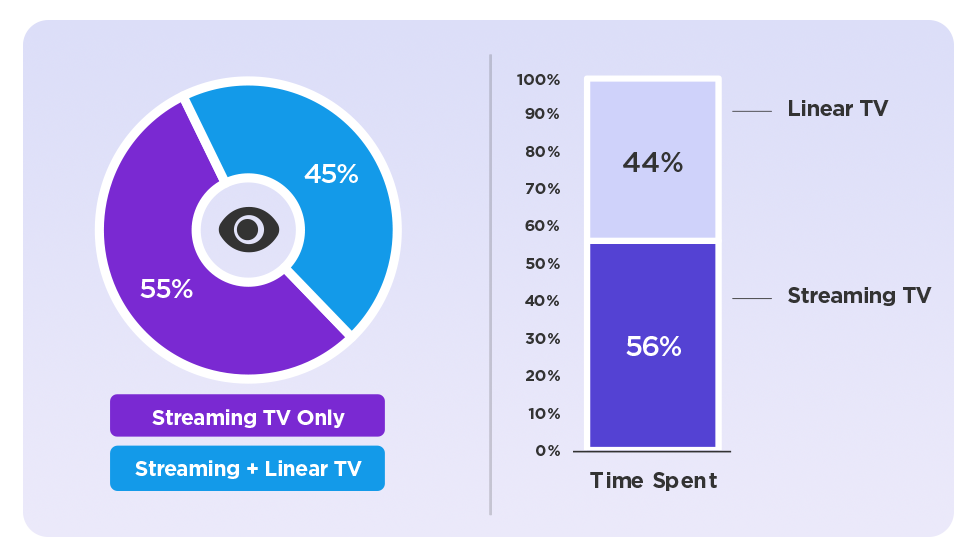
Additionally, Roku’s analysis reveals that 55% of 50-and-over households owning a Roku TV are cord cutters, meaning they don’t pay for traditional TV. And those in the same demo who do still consume linear TV spend 44% of their viewing time watching it, according to Roku ACR data. The other 56% of the time, they’re streaming.¹
That raises another important point, in that many marketers assume their media buys on streaming are duplicative to their linear buys. On the contrary, 92% of reach from all pharma campaigns that ran on Roku in Q3 2022 was unique to linear TV.² We also found that across categories with the highest ad spend, pharmaceutical brands suffer from 35% lower awareness among cord-cutters than among linear TV viewers.³
If pharma brands don’t consider TV streaming ads, they are missing out. One pharma brand traditionally advertised on linear TV but turned to Roku video ads to reach consumers 45 and older. The results were powerful. The brand found that 75% of viewers reached via Roku on TV streaming could not have been reached through linear TV. The ad also provided exclusive reach to 1.8 million viewers. We even found that shifting the budget to TV streaming by just 5% could increase the campaign’s reach by 14%.⁴
Why did 50+ audiences flock to TV streaming? Pandemic and FOMO.
It’s no surprise that older demographics have turned to streaming. Older demographics don’t want to miss out on the next big show or the ability to rewatch a beloved series any more than younger audiences do. If everyone is watching Yellowstone or Stranger Things, people over 50 likely will too.
The pandemic also played a role. As people hunkered down, they wanted more viewing options. Meanwhile, younger people in multigenerational households introduced parents and grandparents to streaming — and it stuck. No wonder: The library of content is seemingly endless, the remote control is simple compared to complex cable remotes, the interface is clean, and the search functionality just works. Older viewers quickly got hooked.
How pharma brands win on TV streaming
For health-oriented advertisers, the paradigm shift to TV streaming means their traditional TV ad buys lack the reach they once had — and many 50+ streamers are now missing completely from linear environments. Instead their ads reach the same linear viewers over –and over.
Meanwhile, it’s difficult to calculate return on investment (ROI) because linear TV does not provide granular viewership data.
Streaming, on the other hand, provides plenty of ROI opportunities. Each Roku device provides a unique data profile of the viewer. Our team can determine which apps, shows, or movies your preferred audience watches most — and run ads that only reach that programming. This reduces waste and avoids duplication. And our platform makes it much easier to measure household penetration and return on ad spend compared to traditional TV. We partner with the best in the business to prove performance, with privacy safe measurement partnerships with DeepIntent, Nielsen, Crossix, and IQVIA.
How to get started
At Roku, we’re seeing investments shift away from linear TV into streaming. However, these brands have, in large part, yet to achieve the reach and frequency needed to move approximately 50% of the market that cannot be reached in linear.⁵ Furthermore, shifting budgets is one part of the equation, but expanding channel allocation into streaming for brands with older patient populations is a ‘must-do’ in 2023.
These marketers may not know that 50+ viewers are streaming on Roku — the prime audience for certain pharma ads.⁶ And we have extensive Roku viewer data on these audiences’ programming preferences. For instance, they tend to love Westerns, home-and-garden shows, and medical dramas. Ads running on these genres resonate especially well.
As for effectiveness? For pharma marketers concerned that streaming TV ads won’t work, I suggest working with a streaming service with scale. Streaming TV is a land of walled gardens and fragmented audiences — but platforms like Roku can break through and ensure your ads appear against a show or movie regardless of which streaming service broadcasts it.
Another strategy is to partner with experienced streaming ad professionals who know how to make these ads work. They can help identify the audiences you want to reach, understand their streaming behavior, and create a plan to engage with them.
But don’t try to find those viewers on linear TV. They aren’t there.
Want to learn more about TV streaming? Sign up to receive our monthly newsletter.
¹ Roku Internal Data, 2022
² Roku Internal Data, Reach Insights Norm Q3'22
³ Roku + Lucid Pharmaceutical Survey, October 2022; N=853; Non-Roku Pay TV users N=976
⁴ Campaign Dates: Q2 2021
⁵¯⁶ Roku Internal Data, 2022