Subscription video on demand (SVOD) platforms have moved on from the “growth at any cost” mindset that defined the early years of streaming. But their new focus on profitable growth has brought its own challenges, including an uptick in subscription cycling.
Subscription cycling is the practice of canceling one service before signing up for another, and it’s becoming widespread. According to Antenna, nearly 1 in 4 U.S. streaming consumers are serial churners.¹
As the leader in ad-supported reach, Roku conducted a survey of our users to help our Media & Entertainment marketers understand how they can achieve sustainable growth in a high-churn environment. We learned that the situation is far from dire, and that SVOD marketers have a bunch of tools available to build lasting loyalty with subscribers.
Below we share insights from our Media and Entertainment 2024 Consumer Pulse Survey,² with specific guidance for SVOD players who want to keep subscribers for the long haul.
#1: Prevent churn with annual plans
Once seen as a cost-saving alternative to cable packages, streaming costs have become burdensome for many households. Roku users reported that total cost was their top factor in deciding how many paid streaming services to subscribe to.³
Annual plans can help to persuade audiences who are worried about their total streaming outlay. These plans, which offer cost savings in exchange for a 12-month commitment, currently account for only 4% of SVOD subscriptions in the U.S., according to Antenna.⁴
Annual plans have the potential to mitigate churn. Retention gets easier after streamers have subscribed to a service for a year. Churn rates fall dramatically –– by as much as half!⁵ There is potential to bring users into annual plans. Our survey discovered that Roku users are open to adopt annual plans, with one in three Roku streamers saying they were likely to go annual over monthly.⁶

A popular SVOD service recently found that promotional offers involving deep discounts were the most effective way to drive annual subscriptions. When a standard annual plan offered savings of less than 20%, only 3% of prospective customers took the deal. But when they ran a promotional campaign promising a 60% savings, over half of the exposed audience chose an annual subscription.⁷
Importantly, viewers drawn to annual subscriptions don’t only prioritize cost. They balance value with still being able to watch all the content they love.⁸ Marketers promoting annual plans should make it clear they offer a wide range of favorites and highlight the depth and diversity of their library.
Roku Recommends: By timing these offers carefully, marketers can boost adoption of annual subscriptions and avoid devaluing the service in the eyes of consumers. Make promotional pricing an event with Marquee Ads on the Home Screen that pair offers with unique seasonal moments such as the start of sports seasons, major tent pole releases, retail events like Black Friday, and the start of the year as families reevaluate their yearly budgets. Capture users with a mind-set to purchase by promoting these pricing events on Roku’s Streaming Store Masthead.
#2: Ease subscription fatigue by marketing your bundles
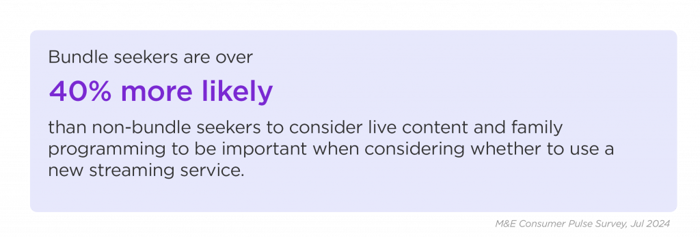
With so many services out there, streaming bundles have gained popularity as a way for consumers to manage costs and reduce household subscriptions. Nearly half of Roku users surveyed said that the ability to bundle with other services was important when considering whether to sign up for a new streaming service.⁹
With cost savings in mind, bundle seekers are 1.3x more likely to choose annual plans than streamers who don’t bundle.¹⁰ But while savings is a driving consideration for bundlers, these customers were also 14% more likely than non-bundle seekers to cite a service’s content as the top factor in their decision making.¹¹
Roku Recommends: When choosing a potential bundle, streamers heavily prioritize packages that offer a wide range of content, including live content (47% more important than for non-bundlers), family programming (45%), new and original content (35%), and sports (22%).¹²
In marketing their bundles, advertisers should leverage cultural moments like major sporting events and award shows to promote live viewing. And they should pair tentpole originals with family friendly content and other programming to position a bundle as a one-stop-shop for the entire household. Use video ads on Roku to tell the full story of the bundle.
#3: Lead with value (and nostalgia TV) when talking to Gen Z
Contrary to popular belief, Gen Z consumers don’t spend all their time on social media. Zoomers are heavy streamers, spending an average of 3.9 hours per day streaming compared with 3.4 hours spent browsing social.¹³ They’re also more open to ad-supported subscriptions than the average Roku user, making them a highly monetizable and highly reachable audience.¹⁴ And 6 in 10 Gen Z streamers have Roku, double the adoption rate of the nearest competitor.¹⁵

Importantly, streaming services don’t need to rely on originals to attract a Gen Z audience. These young folks love nostalgic content, and our survey reveals they are more likely than the average Roku user to use a new service if it offers old favorites and classic entertainment.¹⁶ Therefore SVOD marketers should look to their back catalog –– in this case, shows and movies from the 90s and 2000s –– to drive subscriptions.
Roku recommends: Gen Z Roku users have cost in mind above all, and they are more likely to choose an annual subscription plan than other streamers.¹⁷ Advertisers can lead with value when pitching to this demographic, highlighting cost savings through ad-supported tiers and special offers for annual plans.
Take action for the future
As the lead-in to all TV, Roku is there the moment viewers turn on their TVs, giving us unique insight to the trends and tastes shaping the future of streaming. By offering annual plans, marketing bundling options and demonstrating clear value for their money, SVOD services can meet their subscribers’ desire for cost savings and diverse content in ways that will them coming back. By following these steps, M&E marketers can retain subscribers and pivot to profitable growth for the long haul.
Want to learn more about how our advertising solutions can serve your subscriber goals? Contact us or reach out to your Roku Rep.
¹ Antenna State of Subscriptions, March 2024
² A random sample of Roku users in the U.S. participated in an email-based survey from ~Jul 25 2024 to ~ Aug 9 2024. Data is reported based on self-identified behaviors to reflect the most current and applicable audiences. Results were weighted by age and streaming hours to match the overall Roku audience
³ M&E Consumer Pulse Survey, July 2024
⁴ Antenna State of Subscriptions, June 2024
⁵ Antenna State of Subscriptions, Mar 2024
⁶ M&E Consumer Pulse Survey, July 2024
⁷ Roku Internal Data, Q2 2024
⁸⁻¹² M&E Consumer Pulse Survey, July 2024
¹³ Luth + Roku Gen Z Study, 2024 | Methodology: 15-minute quantitative online survey, n = 1029 males/females 16 to 54 years of age. Respondents must have both streamed and used social media in the past 30 days
¹⁴ M&E Consumer Pulse Survey, July 2024
¹⁵ Luth + Roku Gen Z Study, 2024
¹⁶⁻¹⁷ M&E Consumer Pulse Survey, July 2024