There’s nothing quite like the buzz at Groceryshop, the can’t-miss gathering of approximately 4,000 grocers, CPG brands, and tech companies. During the September 19-21 conference in Las Vegas, industry leaders shed light on the nuances of the ever-evolving grocery retail business.
Key takeaways? Consumers demand seamless shopping experiences offline and online, retail media is hotter than ever, and purpose-driven companies have an edge in today’s market when connecting with consumers.
Let’s dive in.
Clicks and bricks: why omnichannel marketing is critical
Despite increases in online shopping in recent years, most people still buy groceries in stores. A 2022 Gallup poll found that 97% of U.S. adults grocery shop in a store at least monthly while the percentage who order online has jumped from 9% in 2017 to 28% in 2022. According to Groceryshop speakers, shoppers who toggle between online and offline tend to spend more overall and be more engaged.
In response, brands are blending their in-store and digital experiences. Many brands are leaning towards smart cart technology that allows shoppers to spend less time waiting in line and more time shopping in-store.
The Roku advantage. With consumers bouncing between screens and stores, brand visibility is critical to stay top-of-mind wherever consumers buy. Roku boasts 73 million active accounts, many of whom aren’t reachable through traditional TV ads. In fact, TV streaming now reaches 74% of the valuable 18-49 age demographic while traditional TV reaches just 61%.¹ Brands can cast an even wider net with OneView Maximum Reach, our optimization algorithm that dynamically adjusts the distribution of ad exposures to maximize reach while lowering the cost of acquiring new household viewers. They can also tap into Roku’s Primetime Reach Guarantee to reach more TV homes in primetime than the average program airing on a top-five cable channel.
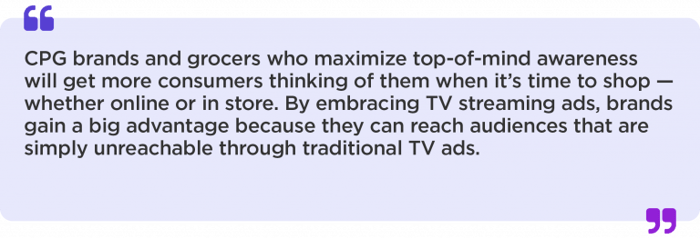
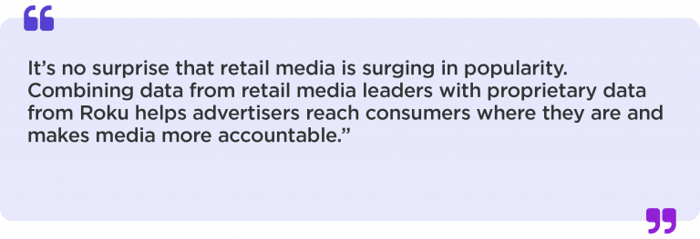
Alannah Pawlik, senior sales marketing manager at Roku says,
Retail media is (still) red hot
Retail media’s soaring trajectory was palpable at Groceryshop. With third-party cookies crumbling, first-party consumer data is now the Holy Grail of digital advertising, enabling greater reach precision along with the ability to measure whether an exposure resulted in in-store or online sales.² Retail media spend will rise to a whopping $106.1 billion by 2027, up from $45.2 billion in 2022.³ The momentum is so compelling that some Groceryshop speakers boldly said that grocers should pivot to think of themselves as retail media companies first. Additionally, companies are evolving their organizational structure to ensure they’re setup successfully as retail media continues to grow.
Case in point: Midwestern grocer Hy-Vee unveiled its own retail media network at the event, aiming to foster brand loyalty and deliver highly personalized shopper experiences using data from its 285 locations in eight states.
The Roku advantage. Our Commerce+ program gives TV streaming advertisers the ability to build audiences based on proprietary data from industry leaders like Instacart, Walmart, Doordash, and Best Buy. For example, Roku has partnered with Kroger Precision Marketing (KPM) to leverage first-party customer transaction data from 60 million households, giving TV streaming advertisers the ability to build high-performing audiences and directly attribute conversions from their Roku advertising.
Brands that leverage our joint technology have seen uplifts in sales, household penetration, and return on ad spend. For example, Red Baron used KPM’s deterministic purchase data to engage with Red Baron current and lapsed buyers, along with frozen pizza product category buyers, leading to an 9% uplift in household penetration and nearly 7% uplift in sales.⁴
Hank Dillon, senior strategic partnerships manager at Roku says,
Making a statement: purpose-driven brands shine bright
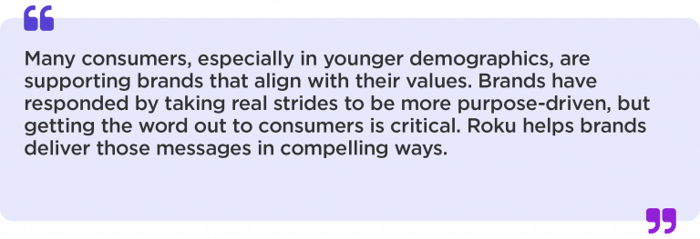
Today’s consumers aren’t just shopping. They’re voting with their wallets and rallying behind brands that champion causes that matter to them. Many want grocers and CPG companies to take a strong position on sustainability and health as well as connect with consumers. Whether they are reducing food waste, using sustainable materials, or focusing on healthful options, brand leaders have found that getting purpose-driven messages to consumers is critical for growth.
The Roku advantage. Roku’s Brand Studio helps companies craft compelling narratives that go beyond traditional 30-second spots. Brands can also tap into unique sponsorships such as home screen takeovers, sponsored content curation, and ways to guide streamers to content they’ll love. Roku can also help brands develop exclusive content that aligns with their brand values — and present it in ways that are engaging to their desired audiences.
Michael Singer, head of industry for beauty, CPG and household at Roku says,
Missed us at Groceryshop and want to learn more? Contact us to set up a strategy meeting for your brand.
¹ Roku Analysis of Nielsen Data, 2023
³ eMarketer, March 2023
⁴ Kroger Precision Marketing, 2022 | Campaign dates: Oct – Nov, 2022