Gen Z is projected to be the largest and wealthiest generation ever — making it a critical audience for nearly every marketer. The oldest members of this 12-to-27-year-old cohort are starting to earn, and the generation’s total spending is projected to rise from $9.8 trillion in 2024 to $12.6 trillion by 2030.¹ Engaging them now could mean securing lifelong customers.
However, capturing their attention isn’t easy. With an attention span averaging just eight seconds, and 99% skipping ads, it’s clear that traditional advertising methods won’t suffice. And if your ad is “cringe” (aka doesn’t pass the vibe check) they’re gone in a flash.²
To understand how brands can successfully engage Gen Z, Roku commissioned a study with Luth Research to explore their digital habits and how they navigate their time across screens. The study reveals that above all else, Gen Z spends the most time streaming and on social media. But Gen Z’s experience on each platform is uniquely different.
Let’s break down the key findings and what they mean for marketers.
1. To our surprise, Gen Z spends more time streaming than anything else.
When it comes to Gen Z’s day-to-day routine, streaming and social media dominate. While gaming, socializing, texting, and other activities are popular, streaming takes the top spot, with Gen Z spending 3.9 hours per day streaming compared to 3.4 hours on social media.³

Takeaway: Gen Z’s time spent on streaming and social media makes up more than a third of their entire day. If you’re missing one or the other in your media plan, you’re missing an enormous opportunity to reach this critical audience.
2. Streaming vs. social media: different experiences, different roles
Though both streaming and social media are vital to Gen Z marketing strategies, the generation’s motivations for using these platforms are quite different. On social media, they’re often in “timepass mode” — browsing TikTok or Instagram to fill time out of boredom, with content passively selected by algorithms. In fact, 74% of Gen Z users hope to randomly stumble upon something interesting (57% higher than streaming).⁴
In contrast, Gen Z approaches streaming with purpose. They come to chill, unwind, and intentionally choose what to watch. Our study found that 76% of Gen Z uses streaming TV to relax (257% more than social media), and 72% turn to streaming for unique programming (80% more than social media).⁵
Takeaway: Streaming and social media should both be core to your Gen Z marketing strategy but treat them differently. Gen Z’s intentional choice to stream can allow for powerful brand storytelling during this experience. Consumer intent also plays a powerful role in influencing mindset.
3. Mindset influences advertising receptivity
Heavy social media use represents a growing mental health concern for Gen Z. Around 80% report negative impacts from social media, including low self-esteem, difficulty focusing on reality, and bullying. More than 1 in 5 (21%) say social media led to damaged relationships with loved ones.⁶
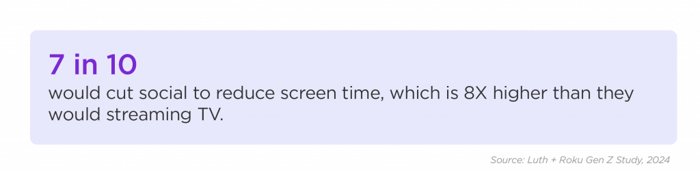
When it’s time to reduce screen time, 69% of Gen Z said they would cut back on social media — 8x higher than those who would reduce TV streaming.⁷
In turn, the lean-back nature of streaming helps put viewers in the right mindset for ads. Eight in 10 Gen Zers feel calm and positive when streaming,⁸ and they’re 73% more receptive to ads when in a positive mood. They’re also 47% more receptive when calm rather than anxious.⁹
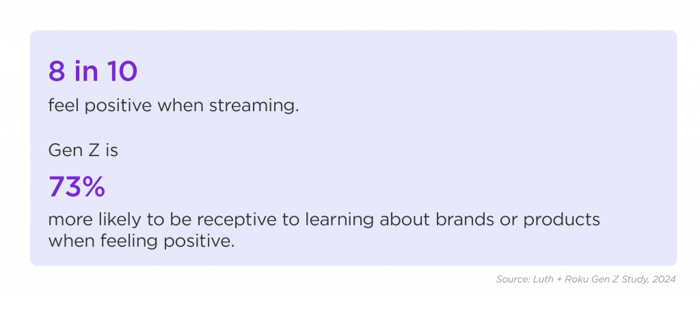
Takeaway: Streaming TV appears exempt from some of the cognitive and emotional side effects that Gen Z associates with social media. When streaming, Gen Z feels positive, and this positivity drives performance for brand messages.
4. Medium influences advertising credibility.
TV streaming offers content of high production value, earning credibility and trust among Gen Z viewers. Our research found that Gen Z perceives streaming TV content and ads as 38% higher in quality and 28% more trustworthy than social media.¹⁰
TV has a long history as an established medium, ads are familiar, and there’s an expectation they should be there whereas on social the placements are a surprise. On social, 1 in 3 Gen Z users associate content and ads with being “shady” or “low quality.”¹¹ There’s less control for brands to determine where their ads show up in each feed, and which surrounding content will be above or below.
Takeaway: The TV screen legitimatizes ads for Gen Z, allowing for more trust and openness to your marketing campaigns.
5. Streaming is social too
While social media promises connection, streaming brings people together in real life. Gen Z is 47% more likely to use TV streaming to socialize with others compared to social media.¹² Watch parties and co-viewing for major TV events are common.
Gen Z prefers streaming for long-form content, with 59% of the shows and movies they watch being long-form, while 58% of social content they watch is short-form.¹³
Takeaway: TV streaming is not only an individual experience but also a communal one for Gen Z, offering unique opportunities for brands to tap into shared moments.
To reach Gen Z, start with streaming
While Gen Z is engaged on social media, they also spend a significant time streaming. And when they do, they act. We found that nearly half of this generational cohort researched brands after seeing a Roku ad, with 1 in 5 going all the way to making a purchase.¹⁴
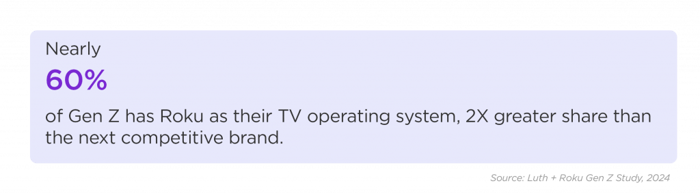
Roku, the #1 TV streaming platform for Gen Z in the US, is where you can meet them. We found that nearly 60% of Gen Z use Roku as their TV operating system, 2X greater than the next, self-reported competitor.¹⁵ Whether you’re delivering video ads on their favorite streaming services, running high-impact native ads, or tapping into Roku City’s screensaver experience, Roku offers innovative ways to connect with Gen Z and drive real results.
Contact us to learn more about Gen Z audiences on Roku.
¹ Nielsen: SPENDZ: Gen Z changes everything.
² AdWeek: A Gen Z Marketer's Playbook for Engaging Advertising
³ Cigna: The state of vitality among Gen Z adults in the U.S.
⁴⁻⁵ Luth + Gen Z Study, 2024
⁶ Cigna: The state of vitality among Gen Z adults in the U.S.
⁷⁻¹⁵ Luth + Gen Z Study, 2024