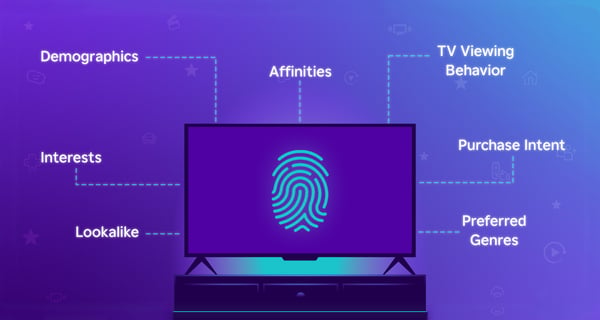
For viewers, this is just TV. For advertisers, it creates a real challenge. As your audience moves across apps, services, devices and buying paths, how can you know who you reached, how often you reached them, and whether your campaign drove action?
The answer starts with CTV identity.
With a dependable identity layer, advertisers get a clearer picture of whether their campaign reached the right audience, found new households, over-served viewers or led to outcomes that matter. In a streaming-first TV landscape, that clarity is what helps CTV work harder and drive better results.
The basics: What is CTV identity?
CTV identity is the framework that helps advertisers recognize audiences across connected TV environments. It links signals like household relationships, device identifiers, viewing behavior and partner integrations. By combining these data points into a holistic identity layer, campaigns can be planned, targeted, frequency-managed, and measured across TV and digital.
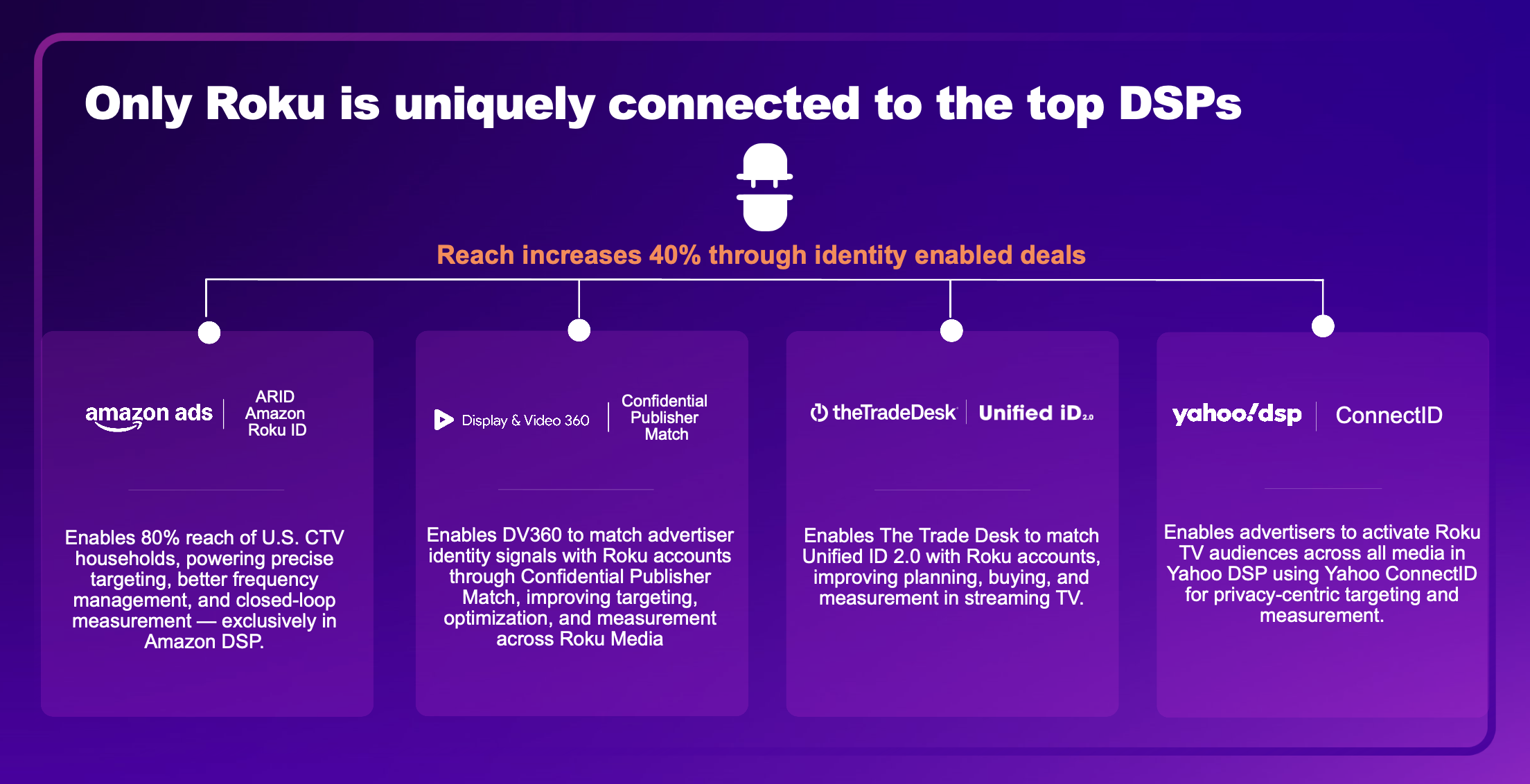
Leading demand-side platforms, including Amazon DSP, Google's Display & Video 360, Yahoo DSP and The Trade Desk, are investing in stronger audience identity resolution for CTV. Roku is partnering closely with each to help advertisers connect streaming signals to real outcomes. The Amazon DSP integration, in particular, brings together complementary first-party data assets to unlock incremental reach and more precise measurement across the streaming landscape.
A durable, privacy-first identity framework is essential to connecting CTV with real outcomes across the consumer journey. As behaviors converge across streaming, searching, scrolling and shopping, first-party identity models deliver precision while respecting viewer trust.
Stacey Weibrecht, Head of Streaming Partnerships, Google Display & Video 360
Drew Goodrich, Senior Director of CTV Inventory development at The Trade Desk, works closely with streaming publishers and advertisers to help make CTV buying more effective. For marketers, he observes that CTV identity is not a nice-to-have layer. It is core to how modern advertising works.
“Identity is critically important to the next stage of CTV evolution. The faster we break down the walls and silos across our industry, the faster we can give buyers the same capabilities in CTV that they expect from mobile, web, and social.”
Drew Goodrich, Senior Director of CTV Inventory Development, The Trade Desk
Marketers may be familiar with mobile identifiers, such as Apple’s IDFA or Android advertising IDs, which help connect ad exposures to targeting and measurement. CTV has a similar connective layer but is inherently more complex. A single household may include multiple viewers, multiple apps and multiple devices, all moving across different streaming experiences.
In the early days of streaming, public IP addresses filled the identity void. But the industry is moving beyond weaker proxies like IP addresses. IP addresses can change, or they may represent a network rather than a true household relationship. Deterministic identity, on the other hand can be built from more stable opt-in household, account, and device signals. That gives advertisers a stronger foundation for planning, activation, and measurement.
How identity contributes to CTV performance and efficiency
For advertisers, CTV identity separates “we ran on streaming” from “we know who we reached, how often we reached them and what happened next.”
Strong CTV identity makes four things possible: greater precision, better outcomes, clearer attribution and an improved streamer experience. Let’s consider each of them in turn.
-
Precision: Advertisers often have a strong understanding of the audiences they want to reach. They know who is signing up on their website, engaging with them on social or showing intent through other digital touchpoints. Identity helps bring those first-party insights into CTV, so advertisers can apply richer signals to reach the right households in a premium TV environment. Instead of relying on broad assumptions, marketers can use a stronger identity framework to target more effectively and reduce wasted impressions.
-
Outcomes: When advertisers reach people more likely to be interested in their product or service, campaigns are better positioned to drive meaningful action. That could mean product sales, brand consideration, app installs, or site visits. Identity helps connect audience strategy to performance by making CTV campaigns more relevant and effective.
-
Attribution: CTV identity also helps advertisers understand how their media spend contributes to results across the customer journey. Was the outcome influenced by CTV? Mobile? Digital? A combination of channels working together? With a strong identity framework, marketers can better connect exposure to action and see which parts of the media mix are driving impact.
-
Streamer experience: High-quality identity means that advertisers can provide viewers with a far more relevant and less annoying ad experience. People see more appropriate products, while improvements in cross-publisher frequency management prevent households from being bombarded with the same ads over and over.
The good news: Persistent CTV identity is now more widely available in advertiser buying tools like Amazon DSP and The Trade Desk. This has led to better advertising for consumers, improved outcomes for advertisers, and monetization gains for publishers’ high-quality inventory. Agency buyers are seeing this shift firsthand.
“CTV identity has completely shifted how we plan media. The ability to bridge identity across different buying platforms allows us to reach desired audiences with more confidence, better control frequency and reduce waste. Basically, our clients can tell their stories effectively without oversaturating households.”
Maikel O'Hanlon, SVP of Performance Media & Innovation, Horizon Media
Behind these improvements is a rise in interoperability between DSPs and streaming platforms— bringing about an identity framework for CTV that supports what marketers have come to expect from their digital, mobile and social campaigns.
How DSP integrations improve CTV identity
Advertisers do not all buy CTV the same way. Some activate through Amazon DSP, others through platforms like Google Display & Video 360 or The Trade Desk. That means CTV identity must be interoperable — and Roku’s open partnership approach gives marketers the flexibility to transact wherever they choose. The Amazon DSP integration goes a step further, operating at the Roku OS level that delivers greater precision, performance, and closed-loop measurement within the streaming experience.
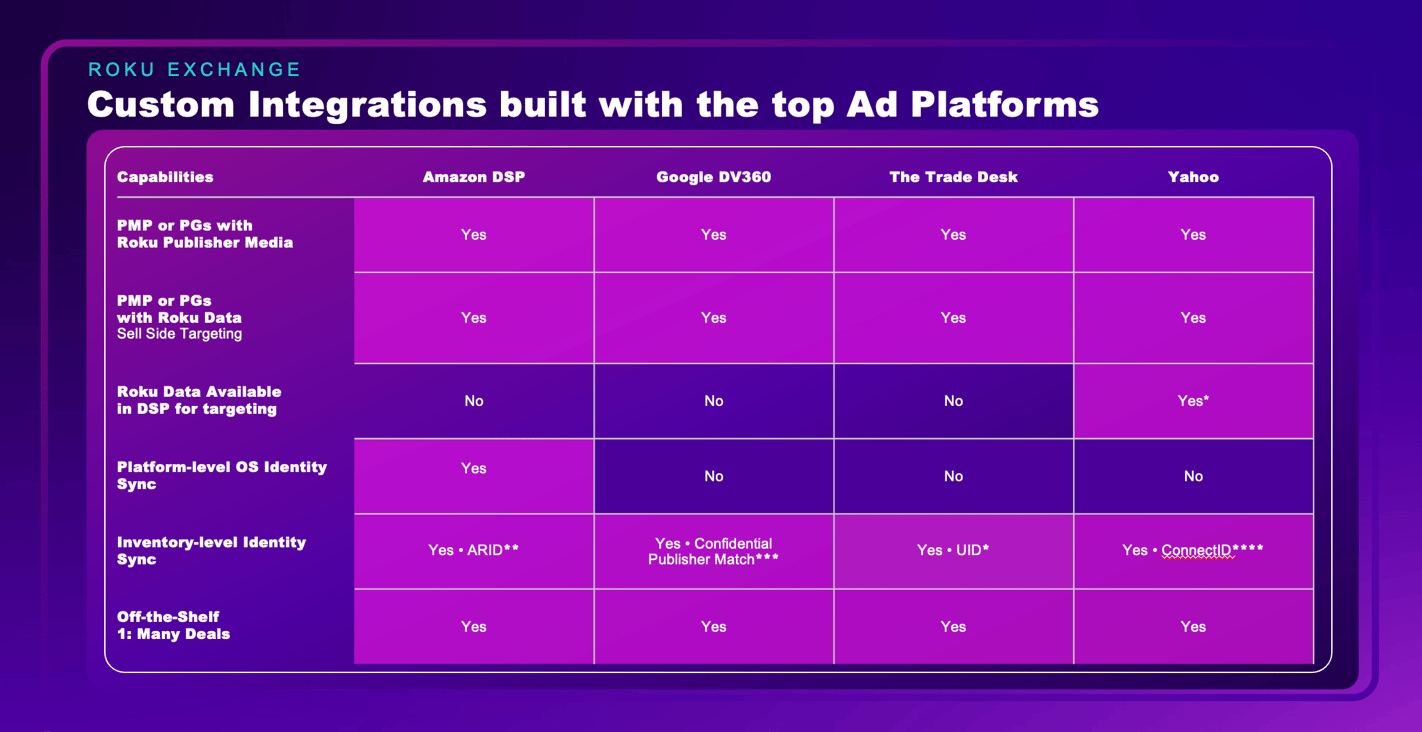
Roku’s identity integrations are designed to make Roku audiences and signals available through the buying platforms advertisers already use. Through Roku Exchange and partner integrations, advertisers can activate Roku Media with stronger identity signals to help support planning, targeting, measurement, and reach and frequency management. No need to rebuild workflows.
For example, Roku works with:
- Amazon DSP through an OS-level integration across Roku devices and apps.
- The Trade Desk through UID2
- Google Display & Video 360 through Confidential Publisher Match
- Yahoo DSP ConnectID
“Honestly, we cannot make advertising work unless we have a strong identity framework,” said The Trade Desk’s Goodrich. “Roku has been ahead of the curve in both its identity strategy and the technology behind it.”
Build campaigns on a stronger identity foundation
CTV identity may sound technical, but its value is practical: better audience recognition, better frequency control, and better measurement. As TV streaming becomes a larger part of the media mix, advertisers need a dependable way to understand who they reached, what happened next, and how CTV contributed to business outcomes. A strong identity foundation makes that possible.
.png?width=1672&height=941&name=image%20(15).png)