
Incrementality is the only measurement method that shows whether your CTV ads caused a conversion or whether it would have happened anyway. MMM and MTA can only infer that answer.
Incrementality testing measures what advertising caused by comparing an exposed group that saw an ad against a statistically identical control group that didn’t. The difference in outcomes between the two groups is the incremental lift.
It’s having a moment as the industry shifts toward outcomes and confidence in other methods slips. But good tests need scale, a stable baseline and no contamination between groups. Here’s how incrementality works for CTV, where it has limits and how to put it to work.
What incrementality does: Proving causal lift
Incrementality testing measures what advertising caused by comparing a group who saw an ad (the exposed group) against a statistically identical group who did not see the ad (the unexposed or control group). The difference in outcomes between the groups is the incremental lift.
The question it answers: What did this advertising actually cause? This is the conclusion the other two measurement methods, MMM and MTA, can only infer.
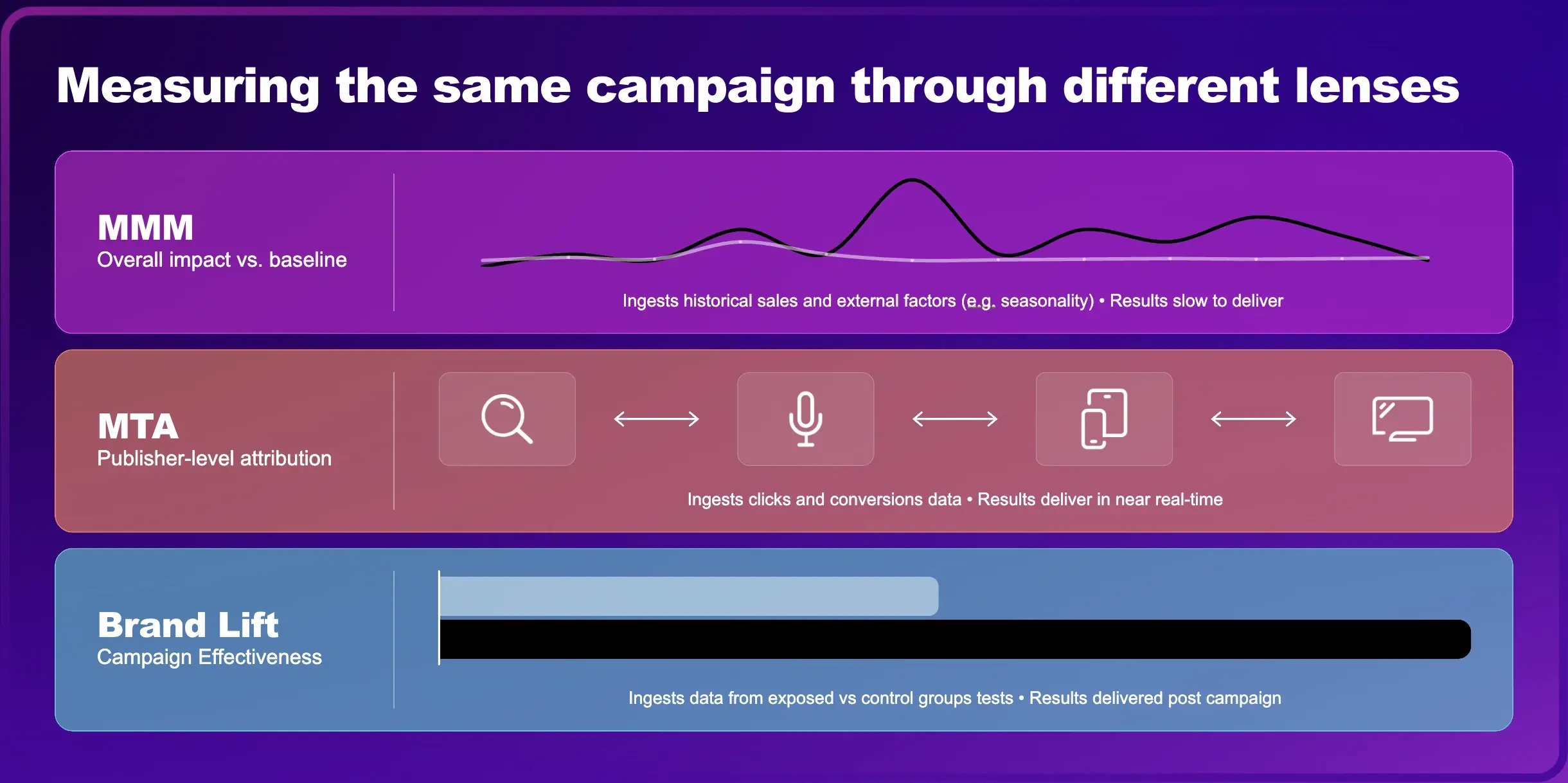
Incrementality is having a moment. The industry’s shift toward outcomes is real, and part of what’s driving it is a loss of confidence in the other two methods. Incrementality answers that skepticism head-on, because it’s built on the logic of a controlled experiment. Compare an exposed group against a matched control, hold everything else equal, and the difference is what the advertising caused.
To illustrate this, imagine handing coupons to shoppers already walking into a store. Last-touch attribution credits the coupon for every purchase that follows. An incrementality test asks the harder question: how much more did those shoppers buy, compared to other shoppers who were not handed coupons? If there’s no difference, then the coupon achieved nothing.
But high-quality incrementality testing requires specific conditions: sufficient scale, a stable baseline, no contamination between groups. Randomized controlled trials are the gold standard, while geo and holdout methods are common alternatives. And incrementality measurement has honest limits of its own. Tests take time; holdouts carry opportunity cost, and a lift percentage without context can flatter small numbers.
Roku’s Conversion Lift capability is built on proprietary data across 100M+ global streaming households, delivering statistically significant lift across the KPIs that matter for advertisers. For media and entertainment brands, this includes installs, first-time views, sign-ups, and streaming hours. Conversion Lift allows you to back into a trustworthy cost-per-incremental action.
Takeaway: Run incrementality on a regular cadence, not as a one-off, and feed the results back. If a channel looks great on last touch but shows little lift, the attribution model is over-crediting it.
If you’re evaluating how CTV shows up in your models, Roku’s measurement team and Measurement Partner Program can help you get the setup right.