

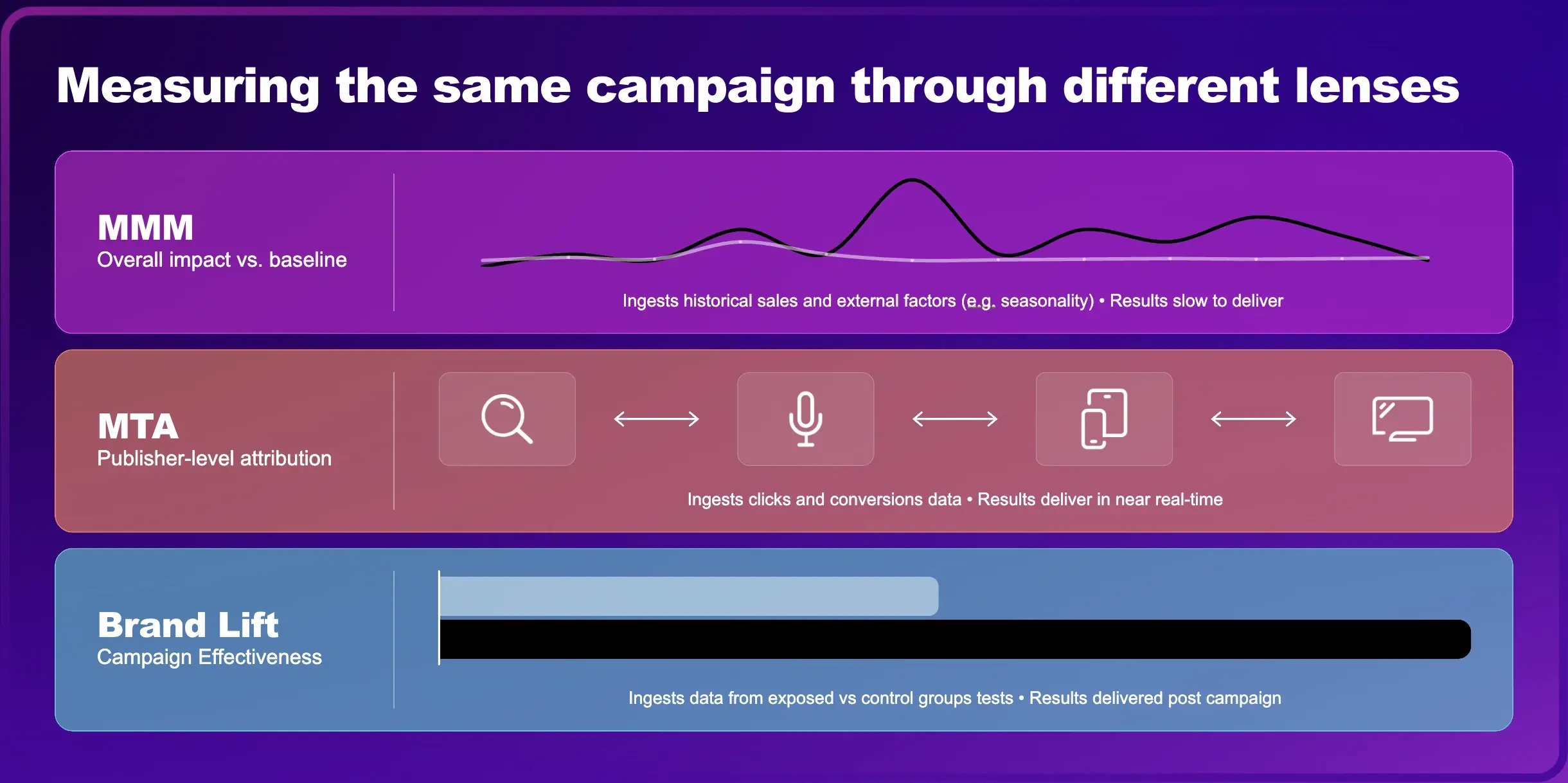
Marketing mix modeling (MMM) is a top-down statistical method that uses aggregate historical spend and sales data to estimate how much each marketing channel contributed to results and how budget should be allocated across them. It doesn’t track individuals, so it’s gaining ground as cookies fade and device identifiers tighten.
MMM answers one question well: across all your marketing, which channels drive results and where should budget go? It answers that accurately only if streaming enters the model as its own channel. Here’s how to set up your MMM to measure CTV correctly.

What MMM does: Allocating budget across channels
Signal loss has changed the measurement conversation. As cookies fade, device identifiers tighten, and walled gardens grow taller, marketing mix modeling has gained stature as the one methodology that doesn’t depend on tracking individuals across the web.
So what is it? MMM is a top-down statistical method that uses aggregate historical spend and sales data to estimate how much each marketing channel (linear, streaming, digital, social), contributed to results, and how budget should be allocated across them.
The question it answers: Across all my marketing, which channels drive results, and how should budget flow? MMM offers a top-down, channel-level view, best suited for long-term planning at the channel level, not publisher or campaign level.
How to represent CTV correctly: Model streaming as its own channel with its own decay curve, saturation point, frequency dynamics, and penetration—not as a line item inside other types of video.
CTV is television-shaped and digitally delivered, so a model that hasn’t decided what CTV itself is can’t know how to score it. To best understand streaming, don’t lump it together with digital video or linear ads.
When CTV looks undervalued in MMM, any of four structural setup issues are usually to blame:
- Streaming has been grouped with linear TV or digital video inventory
- The model has too little media weight to read
- The advertiser has limited historical CTV data
- A model overvalues cheap reach
The good news is, these problems are fixable. When calibrated correctly, we know that CTV performs well in marketing mix models. A Nielsen MMM meta analysis found Roku roughly 2x more effective than the average channel—4.5x vs. social, 3.7x vs. linear TV, 1.6x vs. online video.
Additionally, marketers should ensure their MMM models have enough media weight to generate a real signal; a model can’t learn from spend it barely sees. They should also make sure the model rewards quality, not just efficient reach. Attention, viewability, and completion look expensive next to low-CPM impressions until the model is built to see what those impressions actually deliver.
Ask your MMM vendor: Is streaming its own line, separate from linear and digital video? What decay curve is assumed, and has it been validated through incrementality testing? How often is the model recalibrated?
Takeaway: MMM answers the allocation question well—but only if streaming enters the model as itself.
If you’re evaluating how CTV shows up in your models, Roku’s measurement team and Measurement Partner Program can help you get the setup right.